POLITICS
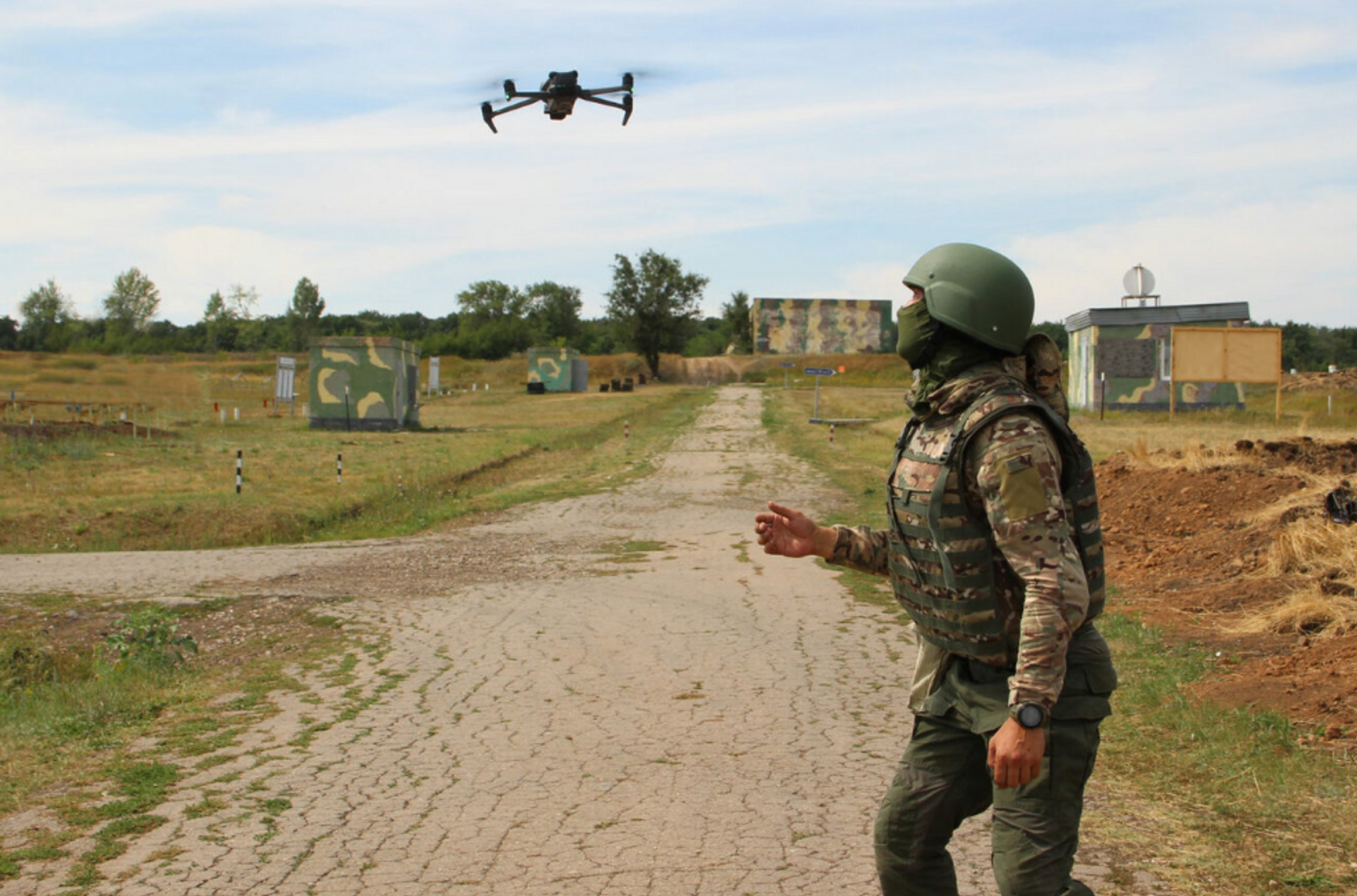
According to open sources, more than 200,000 Russian soldiers have been confirmed killed in Ukraine, and the influx of new contract recruits has noticeably dried up in the fifth year of the full-scale war. Struggling with the shortage of personnel on the frontline, Russia’s Ministry of Defense has launched a campaign to enlist students to fight, an effort spanning more than 80 colleges across the country. They are being lured into the drone forces with promises of large payments, academic leniency, and state-funded tuition. Some institutions emphasize the advantages of the “new specialty,” while others threaten underperforming students with expulsion to get them to sign a contract. The Insider spoke with students, professors, and lawyers about the ongoing “hunt” for recruits and possible ways of resisting the campaign.
“The university is just providing information”
“A unique opportunity from the Ministry of Good”
Mass recruitment campaign
What to do — and why proving pressure is almost impossible
“Join the team of the future” — this is the slogan used by the RANEPA university branch in the city of Vladimir to promote a “promising” opportunity for students to reach their full potential. The university’s official website advertises a course for UAV operators — “one of the most in-demand specialties in the modern armed forces.” It is specifically emphasized that recent high school graduates are promised service exclusively in drone units located “away from the front line.”
The language reads like a presentation for a continuing education program, but in reality it is an advertisement promoting contract service with the Ministry of Defense. RANEPA is just one of dozens of Russian colleges and vocational schools that have integrated recruitment for the Russian army into the educational environment. The campaign is carried out through official websites, mailings, banners in student apps, assemblies in auditoriums, and one-on-one “consultations.”
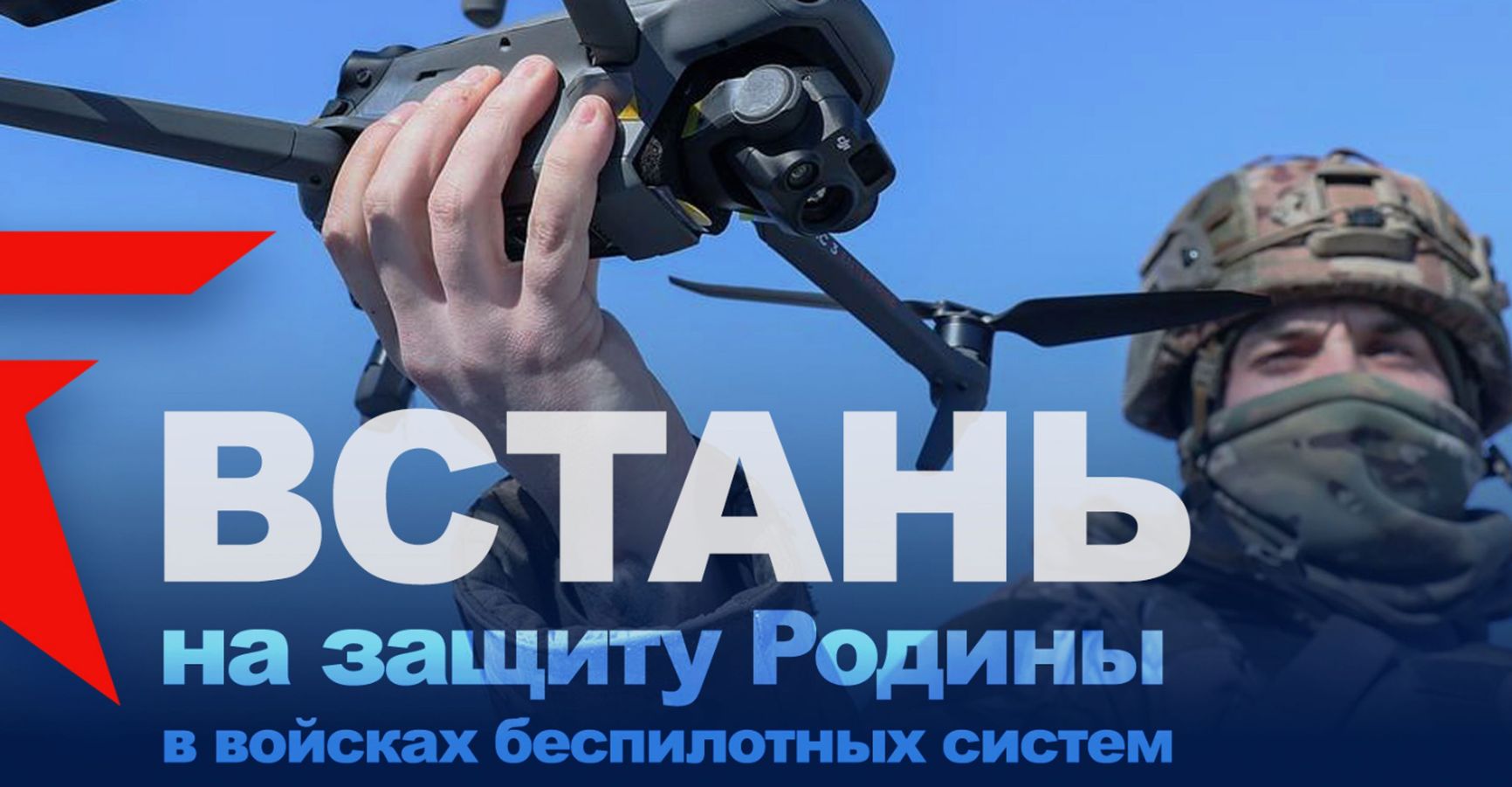
As officials at the Siberian Federal University in Krasnoyarsk explain, “young people are best suited to operating UAVs because they ‘have been interested in mobile phones and computer games since childhood.’” Meanwhile, the Russian University of Transport (RUT MIIT) places an emphasis on academic and professional benefits, promising a leave of absence for the duration of the contract and the possibility of switching to state-funded tuition after service.
“‘You play computer games anyway — so what’s stopping you from becoming a UAV operator?’ — that’s what they told us at the meeting,” says Ivan (name changed to protect identity), a student at the College of Space Engineering and Technology at the A. A. Leonov University in Korolyov, Moscow Region. According to Ivan, the meeting with recruiters took the students by surprise.
“During class, the professor said that advertisers would be coming and warned that anyone who left would have to write an explanation. This happened in all the groups — everyone was threatened with written explanations, absences, and failing grades. Classic,” he says.
According to Ivan, the professors had mixed feelings about holding such a “meeting.” “Some openly said they didn’t like it, but they still brought the students to the classroom, first explaining the situation to them,” he recalls.
According to Ivan, even before the “lecture” relations with the administration had soured, and a Telegram channel captured many of the problems — cases of bullying, incidents involving rude professors, problems with infrastructure, and pressure to switch over to the Russian state-backed Max messenger. In the same Telegram channel, students also wrote about the coercion they faced from the “advertisers.”
The suspected administrators of the channel were summoned to appear before a disciplinary committee, which included college director Elena Antropova, student council chair Andrey Morusak, first deputy director of the branch Nikolay Kruglov, and several other staff members.
“You say things are bad at the college, bad at the university. And you broadcast this to the whole nation. All your posts, which you write for 98 people, end up in other chats and groups with more than 200,000 subscribers. Especially the post about the drone forces. The university is just providing information. If you had attended the meeting, you would know that. But you write that they force and coerce students to attend these meetings,” the committee members said.
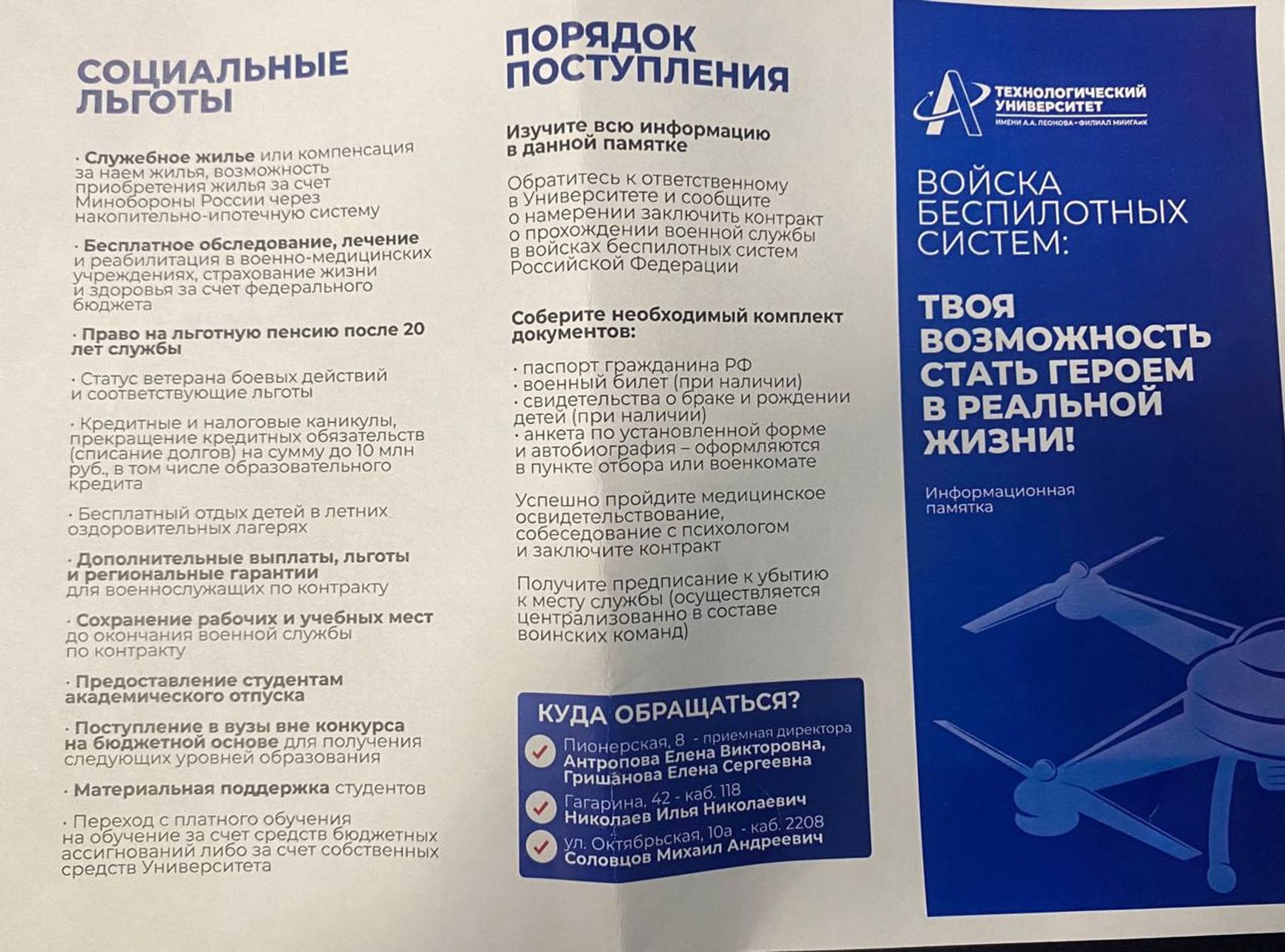
Meanwhile, similar meetings at the A. A. Leonov Technological University (the parent organization of Ivan’s college) describe service as a UAV operator as an opportunity to acquire “practical skills,” ranging from repairing drone systems to working with 3D modeling. Students are handed brochures with the slogan that signing a contract is a “chance to become a hero in real life.”
These are not isolated cases. On the welcome screen of its student app, Bauman Moscow State Technical University is displaying a banner offering students the chance to join drone units. The administration of Saint Petersburg State University went even further, offering students to boost their military contract payments with a “special scholarship” from the university — 50,000 rubles ($630) per month.
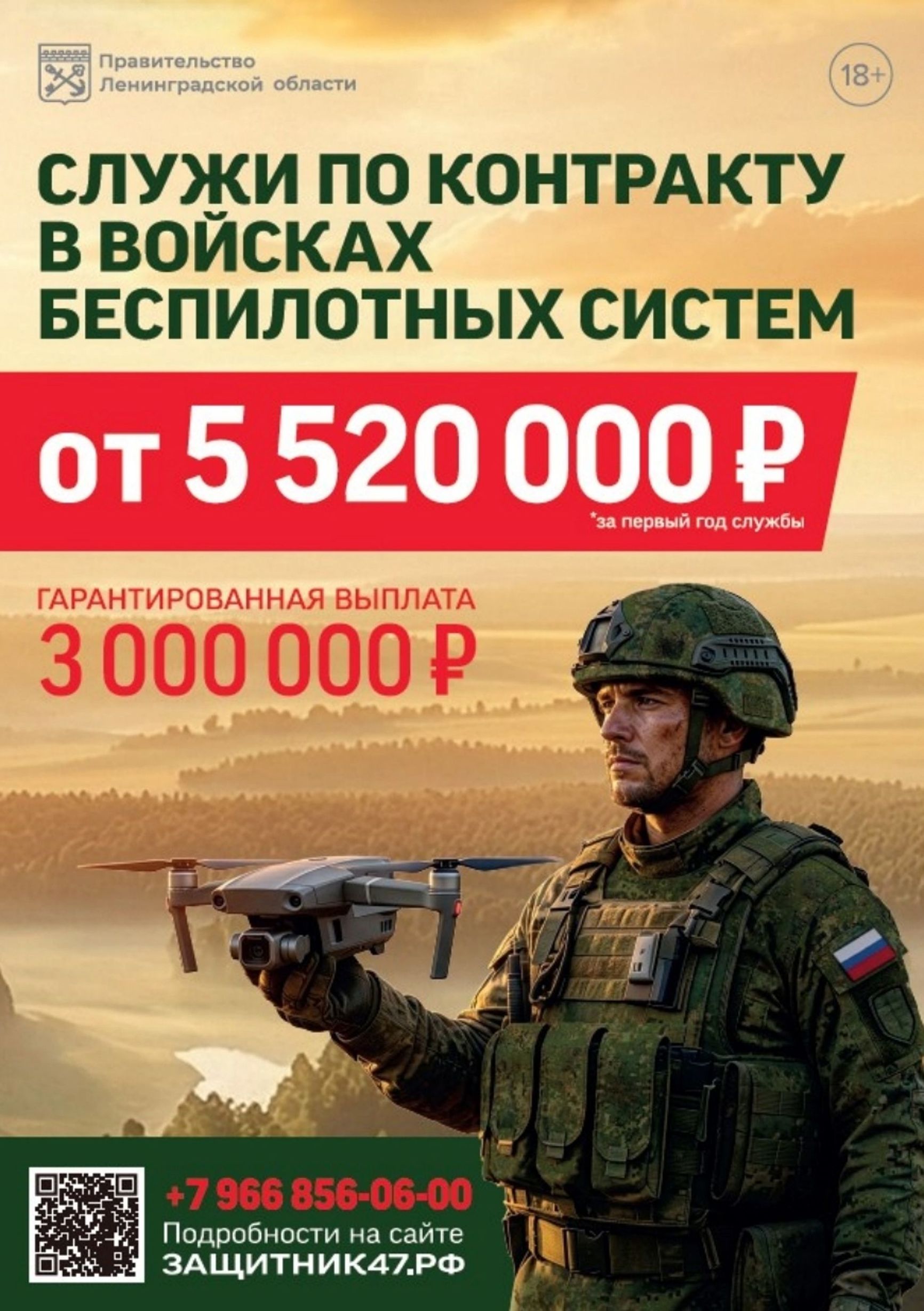
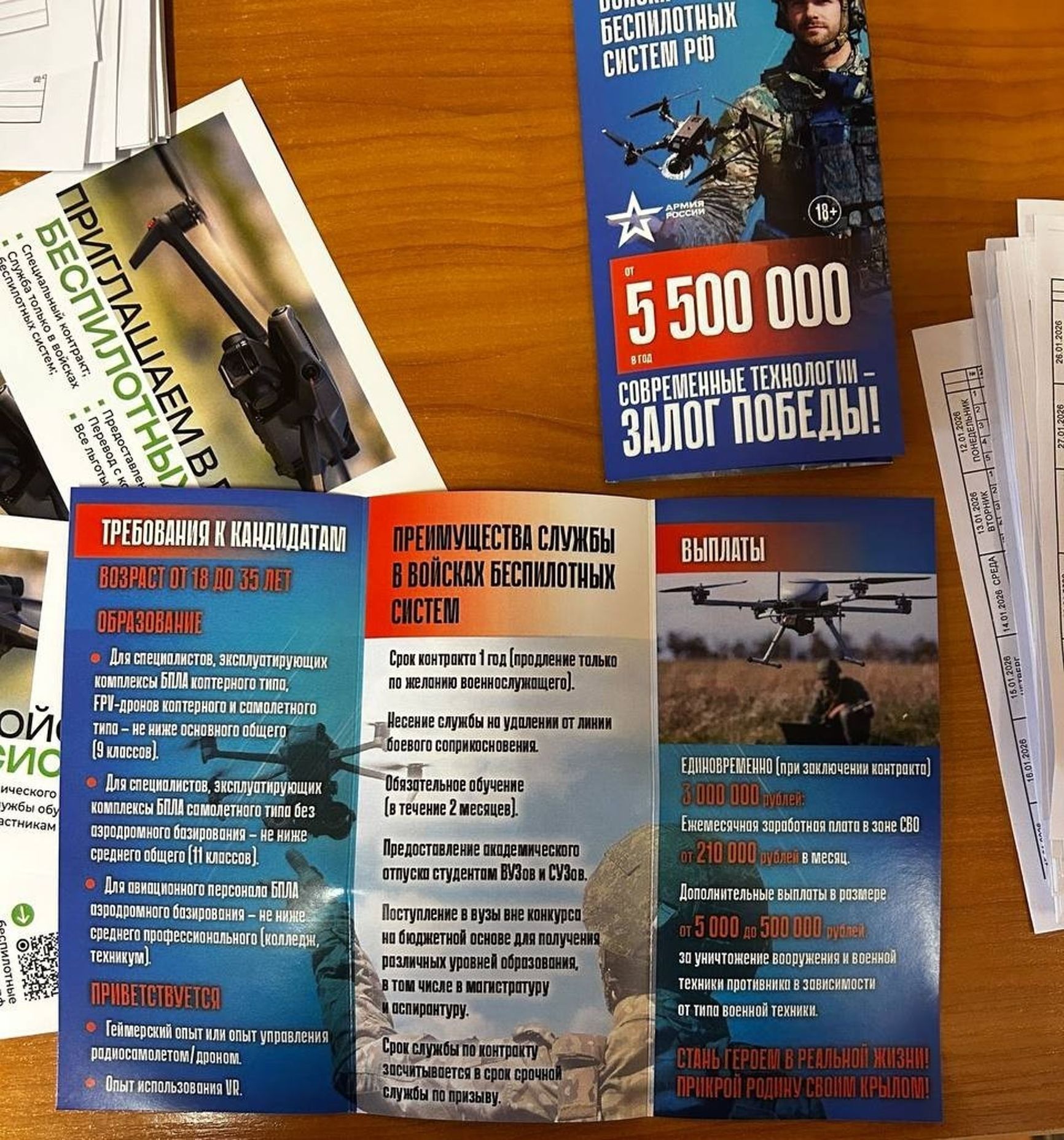
Some educational institutions are publishing estimates of the expected payments (1, 2). The presentations feature amounts ranging from 2 to 6 million rubles ($25,000-$75,000) for the first year of service, figures that vary based on federal and regional bonuses. The financial benefits are presented alongside promises of a “safe specialty” and a “guaranteed” contract termination after one year.
Recruitment and pressure in vocational schools are even more intense than in higher education institutions. Maria Kirsanova, the director of the Lunin Novosibirsk College of Transport Technologies, publicly reprimanded students for refusing to sign a contract — while hinting that those who do sign it could count on quickly obtaining their diploma.
Students at Moscow Medical College No. 2 were not reprimanded — on the contrary, they were told about the many benefits promised by the “innovative” profession. The contract was called a “ticket to life,” and the payment amounts were announced right away.
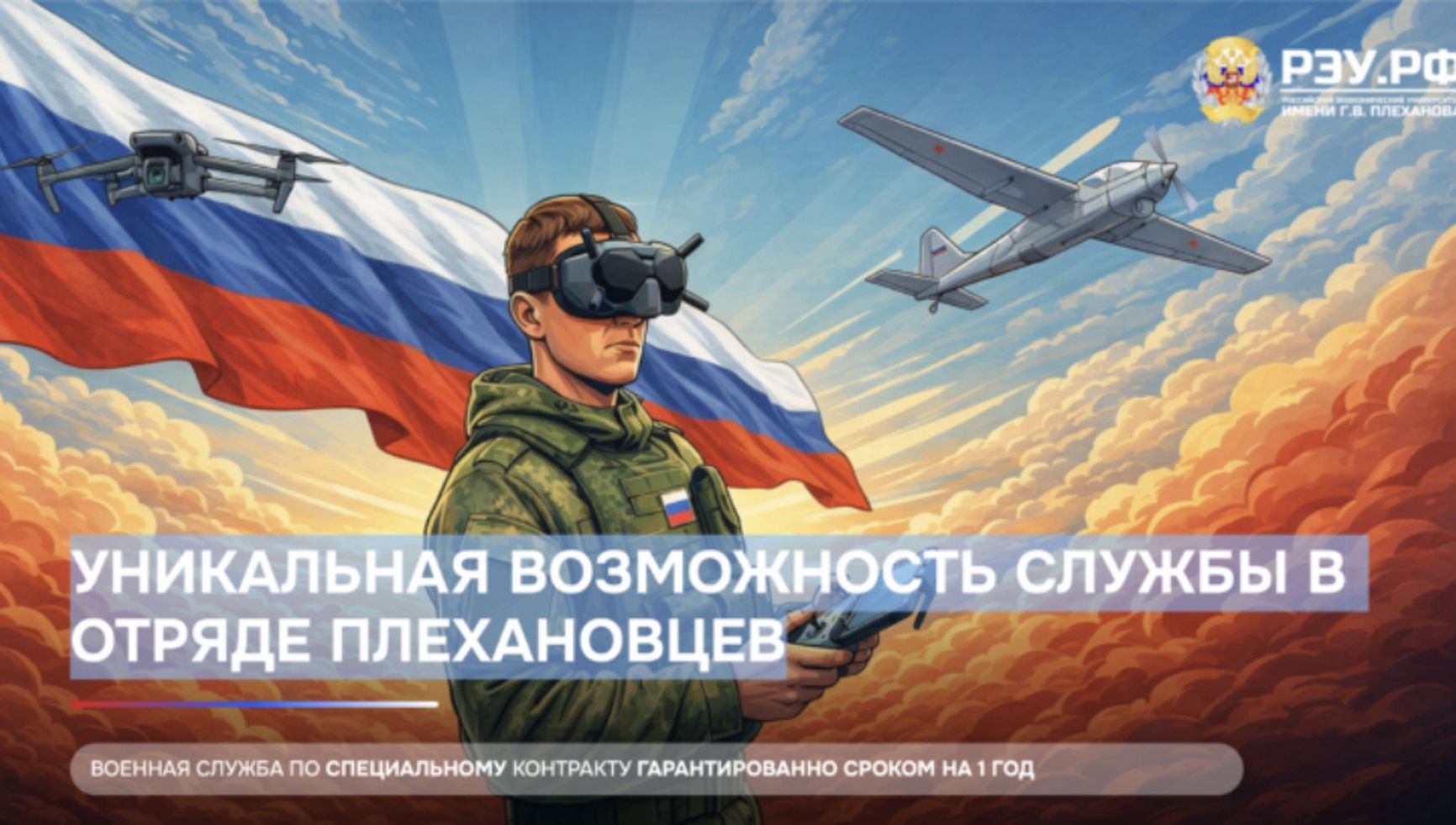
Artyom (name changed to protect identity), a teacher at a vocational school affiliated with Plekhanov Russian University of Economics, offers an inside perspective on these meetings. As he recalls, staff received information about the recruitment of contract soldiers in early February 2026, then students and teachers were ordered to gather in an auditorium.
“They told us roughly how many people should come from each group and warned us not to ask any unnecessary questions — you know what I mean. The auditorium was full, with about a hundred people present,” he says.
Among the speakers were one of the vice-rectors, an active-duty military officer, and representatives of the college administration. From the very beginning, they emphasized that their offer was “not a contract, but an arrangement.”
Artyom’s college adopted an approach based on an overtly positive presentation rather than on outright pressure — as if it were not the Ministry of Defense, but the “Ministry of Good” offering students a unique opportunity. “They did all they could to paint a positive picture — and used a minimum of direct threats,” Artyom says. “The Plekhanov University vice-rector isn’t stupid either: he avoided provocative words and spoke strictly from the script.”
“The Plekhanov University vice-rector isn’t stupid either: he avoided provocative words and spoke strictly from the script”
Students were promised a whole range of incentives: lump-sum payments of up to 5 million rubles ($63,000) for signing the contract, early graduation, veteran combatant status, and enhanced career prospects.
“They said, ‘You’ll be the first to join the elite drone forces. You’ll come home famous,’” the teacher recalls.
The speakers emphasized that the actual service would last less than a year, with two months’ training and another 35 days leave. The initial focus was not on combat missions or drone operation, but equipment maintenance. “A million rubles’ worth of equipment is sitting unused because there’s no one to fix it, and you are smart graduates,” Artyom recounts the talking points. The contract was presented as an opportunity not only to “defend the homeland” but also to learn a new profession.
After the group meeting, the recruiters with interested students individually.
“At individual consultations, they offered more details — and more sugarcoating. They talked about the possibility of taking out a loan up to 10 million rubles [$126,000] with subsequent forgiveness. In other words, they explicitly said you could take out loans now, and the contract would write them off. They spoke about safety and promised that throughout the entire service, students would be accompanied 24/7 by a university mentor, and that they could serve alongside their peers — other students from the same educational institution,” Artyom says, also wondering how such promises can possibly be delivered.
At the same time, the contract appendix includes a clause allowing transfer to another branch of the armed forces if requirements are not met. “Nothing of the sort was mentioned at the general meeting,” Artyom notes.
According to him, around 70 students signed the contract. “I don’t know if that’s just from our college or from all of the Plekhanov institutions. If it’s only from ours, that’s 5–10% of third- and fourth-year students. If from all of them, then it's no more than 1%,” he clarifies.
Plekhanov Russian University of Economics has also launched a retraining program titled “Multirotor Unmanned Aerial Vehicle Operator,” which teaches students to operate drones. In fact, it requires that all college students take a mandatory course in this field.
“These courses feature tests and a variety of practical assignments. The administration made it very clear that completion was mandatory,” he says.
According to Artyom, the assignments are mostly a formality, but attendance in the courses is strictly monitored: “They need to report how many people attended these courses. It looks like money laundering. Sometimes students from other universities attend the classes too. But even Plekhanov University students have to pay for them,” he says.
The first widespread reports of student recruitment for service in the drone forces appeared immediately after the New Year holidays.
“Starting in mid-January, we began receiving complaints from students,” says human rights activist Timur Tukhvatullin. “Some universities limited the campaign to persistent offers. Others threatened students with expulsion for refusal. At first, they were mainly targeting engineering students with academic debts, but now the selection of candidates appears to be random.”
Starting in February, the practice has become widespread. According to Artyom Klyga, legal counsel of the Conscientious Refuseniks Movement, the key role belonged to a Ministry of Defense guidebook distributed to university administrations:
“As far as I know, the guidebook was sent to all organizations, meaning it was a mass distribution. Whether each university was assigned a specific target for supplying recruits, we cannot say yet. For instance, I received reports from Plekhanov University of Economics stating that group leaders were instructed to supply two students per week. So far, it looks like a quota, not a systematic effort.”
Recruitment quotas have already been set at several institutions. Far Eastern Federal University in Vladivostok planned to recruit 32 students by the end of February, and Novosibirsk State Pedagogical University aims for 109 recruits by April 2026. Timur Tukhvatullin notes that specific numbers, “issued from above,” exist both at the regional level and at individual universities.
Maksim (name changed to protect identity), a student at a vocational school affiliated with Peter the Great Polytechnic University in St. Petersburg, says that he recently saw brochures promoting service in the drone forces at his school. “I was shocked because [our administration] had not normally engaged in this type of propaganda and had called a spade a spade, even though they never expressed any oppositional views. But they never made any direct calls,” he says.
According to Maksim, some of his peers signed contracts. “A student from my group signed one. Despite all the promises, he even decided to drop out of school. I don’t know what’s happened to him. As far as I know, he’s alive,” he says.
The teaching staff at Maksim’s vocational school avoid discussing the situation, and most students feel either neutral or negative about the recruitment. There have been some unfortunate incidents, too. “Friends of a guy from another group decided to play a joke on him and left his number on the Ministry of Defense website — supposedly because he wants to sign a contract. Now he’s getting constant calls asking when he’ll sign. He just wanted to quietly finish his studies, and now both the military and the professors are closely watching him,” Maksim recounted.
Underperforming students are in the most vulnerable position. Since late January, Moscow’s Higher School of Economics has been offering students facing expulsion the option to sign a contract in exchange for a resolution of their academic issues. Some universities violate the law by prohibiting students from retaking exams and pressuring them to join the armed forces instead of giving them the chance to make up for falling behind. According to Tukhvatullin, this occurred at Kazan Innovative University (KIU) and Voronezh State University (VSU).
Those without a draft deferment after college are also at risk. Arkady (name changed to protect identity), a graduate student from St. Petersburg, told The Insider that he was summoned to the dean’s office for this very reason:
“On Feb. 10, they summoned everyone whose deferment period was ending, as well as those who had already served or were unfit. The group leader sent the list during class and told us to come the next day to a specific auditorium at a set time. There, the recruitment campaign began.
They told us, ‘If you sign, you won’t waste a year — you’ll earn money while defending the homeland.’ They promised that everything would be fine and safe, and that we would be stationed away from the combat zone, at a distance of 10 to 350 km.”
Students filled out questionnaires right in the hallway, after which each one was called into the classroom.
“The questionnaire included a question about consenting to join the Russian Armed Forces. If you answer ‘no,’ you have to explain why and indicate under what conditions you might agree,” Arkady explains.
According to him, there was no significant pressure, but an explanation was still required from those who refused: “For another two weeks, I received calls from unknown numbers asking if I had considered serving under a contract.” None of his acquaintances gave in to the recruitment efforts.
“They lure students using the same playbook: the same promises, the same guarantees. But most realize the risks. Recruitment at universities may not be as successful as the Ministry of Defense expects. People go to school to get a degree and a deferment from the army, not a contract,” Klyga concludes.
Tukhvatullin agrees. According to him, despite the pressure and the mass distribution of recruitment guidelines, there is no widespread enthusiasm among students:
“The vast majority of students are not interested in the military service offered to them at the university. Students plan to settle their academic debts in the usual way. Some would rather face expulsion, as the level of distrust toward the recruitment effort is very high. Unfortunately, the state understands this, which is why the recruitment is becoming increasingly aggressive.”
According to data collected from open sources and estimates by human rights activists, similar campaigns are taking place in at least 83 universities and 24 vocational schools across 36 regions of Russia (including illegally annexed Crimea). The actual numbers may be significantly higher.
Despite the scale of the campaign, presenting legal evidence of pressure on students would be difficult, says Artyom Klyga. According to him, the situation is reminiscent of the 2022 wave of expulsions over anti-war views: formally, the reason was academic debts, but in reality, it was political. “That’s why it’s better to anticipate such situations and avoid falling into vulnerable groups by obtaining academic credits on time,” he notes.
Academic debts most often become a point of pressure. The administration may hint to the student that retaking exams is pointless, but that their problems will disappear if they sign a contract with the army. In other words, they use an element of the educational process as a tool of coercion.
Academic debts most often become a point of pressure: the administration may hint to the student that retaking exams is pointless
Tukhvatullin advises documenting any pressure from the administration. “You can record your conversations, or you can do it by submitting official statements. If a student is threatened with being denied a retake unless they sign a contract, they should submit a statement to the rector demanding a lawful retake and describe the grounds cited in the verbal refusal they received,” he explains.
Even if the pressure is framed as a “conversation” or a “suggestion to think it over,” documenting it in writing makes it harder for the university to deny what happened.
Once a contract is signed, the options are limited. Human rights activists recommend contacting specialized NGOs — such as the Conscript School, Conscientious Refusenik Movement, and Get Lost — which help defend the rights of conscripts and service members.
At the same time, Tukhvatullin warns that terminating a contract is difficult, especially given that Putin’s mobilization decree is still in force. “I would not advise signing any documents under pressure. You can say that you need time to consider your decision. There’s a chance that the administration will stop pressuring you after a while,” he says.
The Conscientious Refuseniks Movement also published a guidebook addressing key questions about the campaign: whether the contract guarantees service specifically in the drone forces, whether it is possible to refuse transfer to another branch, and whether one can return to their studies after service.
Against the backdrop of promises of a “safe service” and an “innovative profession,” these questions — about the right to refuse and the cost of signing — turn out to be the most important for students considering enlistment.
К сожалению, браузер, которым вы пользуйтесь, устарел и не позволяет корректно отображать сайт. Пожалуйста, установите любой из современных браузеров, например:
Google Chrome Firefox Safari