SOCIETY
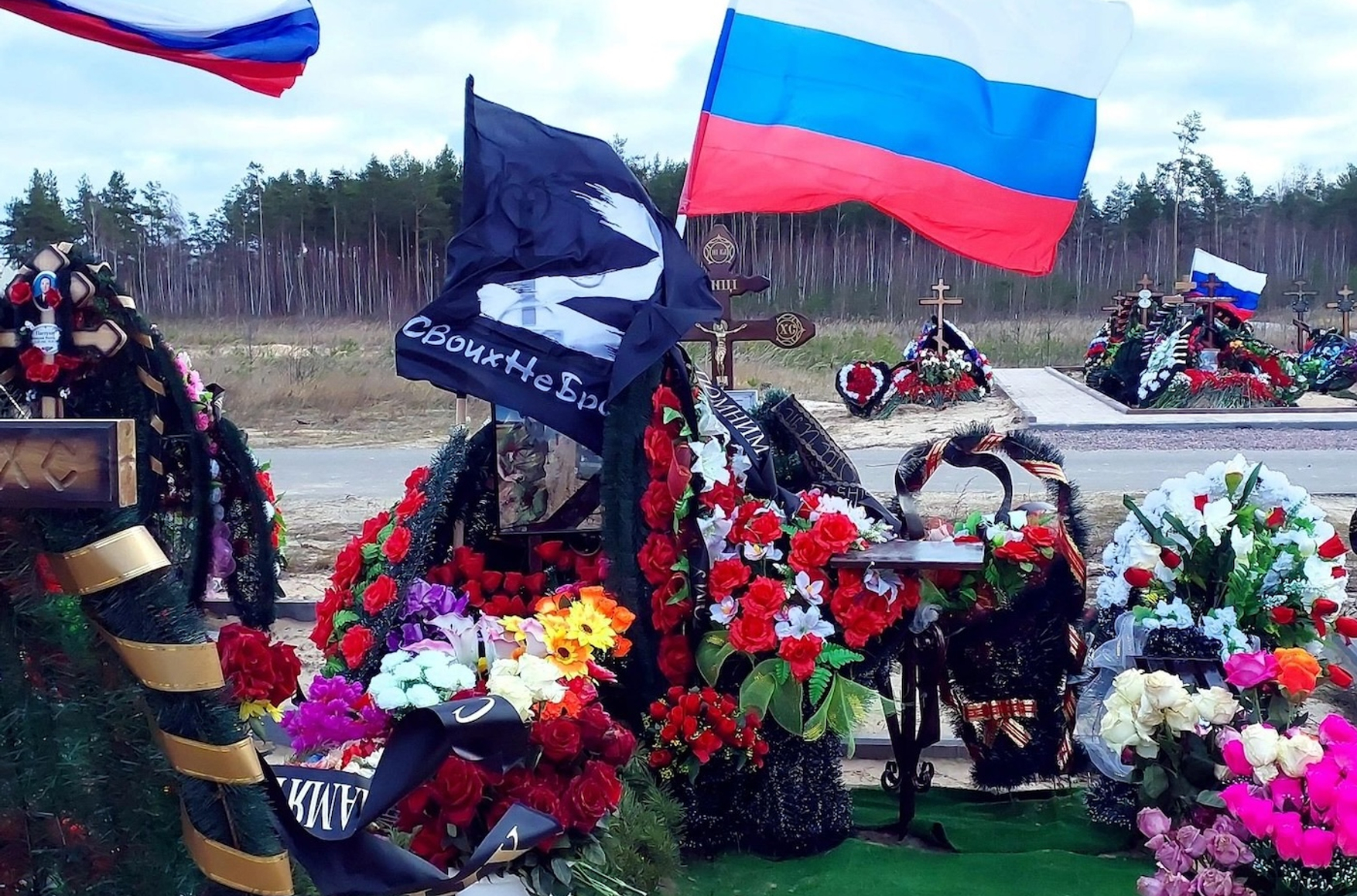
Mortality in Russia is rising, and the funeral industry is expanding right along with it — making the sector one of the few that has shown stable growth in the country since the war began. In the first half of 2025, at least 916,000 people died in Russia, a figure that is higher in per capita than that of the pre-COVID years. Now, however, the dead are increasingly young, and the causes of death are increasingly unrelated to illness. Instead, the funeral market is fueled by a steady flow of coffins coming from Ukraine. Nevertheless, the patriotic burial designs of the war’s first year failed to attract many customers, while the families of civilians are opting for the simplest and most economical funerals on offer.
Deaths from “other causes”
Economics of death
Bodies
Conflict with traditional values
Crematoria
Cheap and eco-friendly
At the end of January, a scandal erupted in Novosibirsk over the bodies of Russian soldiers killed in the war with Ukraine. Relatives of the dead told the media and prosecutors that the military enlistment office was handing over bodies directly from the airport to specific funeral companies without the families’ consent. The war dead have become an important source of growth for the burial industry, and their loved ones are a valuable resource that funeral providers are willing to fight over.
By the end of 2024, the year-on-year turnover of Russia’s funeral services industry had increased by 7.7 percent. Between January and April 2025, it was a full 12.7 percent higher than during the same period in 2024. New funeral companies opened, with growth in the first half of last year reaching 16 percent. The main reason, unsurprisingly, is rising mortality.
In the spring of 2025, Rosstat stopped publishing birth and death data, but in July the Health Ministry released the statistics. It turned out that 916,000 people died in Russia in the first six months of 2025. In absolute numbers, this is slightly lower than in the same period of 2019, when 918,000 deaths were recorded. But per capita, the figures are noticeably higher. Before the pandemic and the war, the mortality rate stood at 12.6 per thousand residents, while in the first quarter of 2025 it was 13.1, a Russian demographer who asked to remain anonymous told The Insider.
The number of deaths is rising slowly — even in the first half of 2024, the increase amounted to only 1 percent — but according to the Health Ministry, the demographic make-up has changed significantly, with men aged 15 to 59 dying in notably larger numbers. The growth did not stem from medical problems (rates for cardiovascular, neurological and respiratory diseases, as well as injuries, actually declined) but from “other causes,” which include war casualties. In the first half of 2025, 102,000 people died from “other causes,” compared with 67,000 in the same period of 2024.
In 2024, young Russians were dying significantly more often, and mortality among men increased more noticeably than among women
For the most part, this rise in mortality is the result of the war, the demographer believes, and the government’s decision to classify statistics indirectly supports this view. “Most likely, mortality in 2025 will be comparable to the annual average for 2023–2024 (about 1.8 million deaths), possibly with a slight increase of up to 5 percent,” the expert said.
This is significant for the funeral sector. When an ordinary person dies, the family receives a 9,000-ruble allowance ($117) — not nearly enough to bury anyone. But the state covers military burials far more generously.
In the summer of 2024, the authorities introduced a federal compensation program for the funerals of servicemen: up to 70,884 rubles ($926) for residents of Moscow, St. Petersburg, and annexed Sevastopol, and up to 51,552 rubles ($673) for everyone else. In addition, up to 49,511 rubles ($646) is allocated for a headstone. There are also regional payments, which vary widely. For example, in Stavropol the family of a fallen soldier receives an additional 30,000 rubles ($392), while in Khakassia the compensation was 1 million rubles ($13,063) until the summer of 2025, after which it was reduced to 100,000 ($1,306).
The flow of state funds has prompted additional markups from the business side. In Vologda, two municipal funeral companies introduced special rates for families of those killed in the war in Ukraine, charging 6,500 rubles ($85) per day for storing a body and 4,000 rubles ($52) for disposing of the container in which the military delivers the remains.
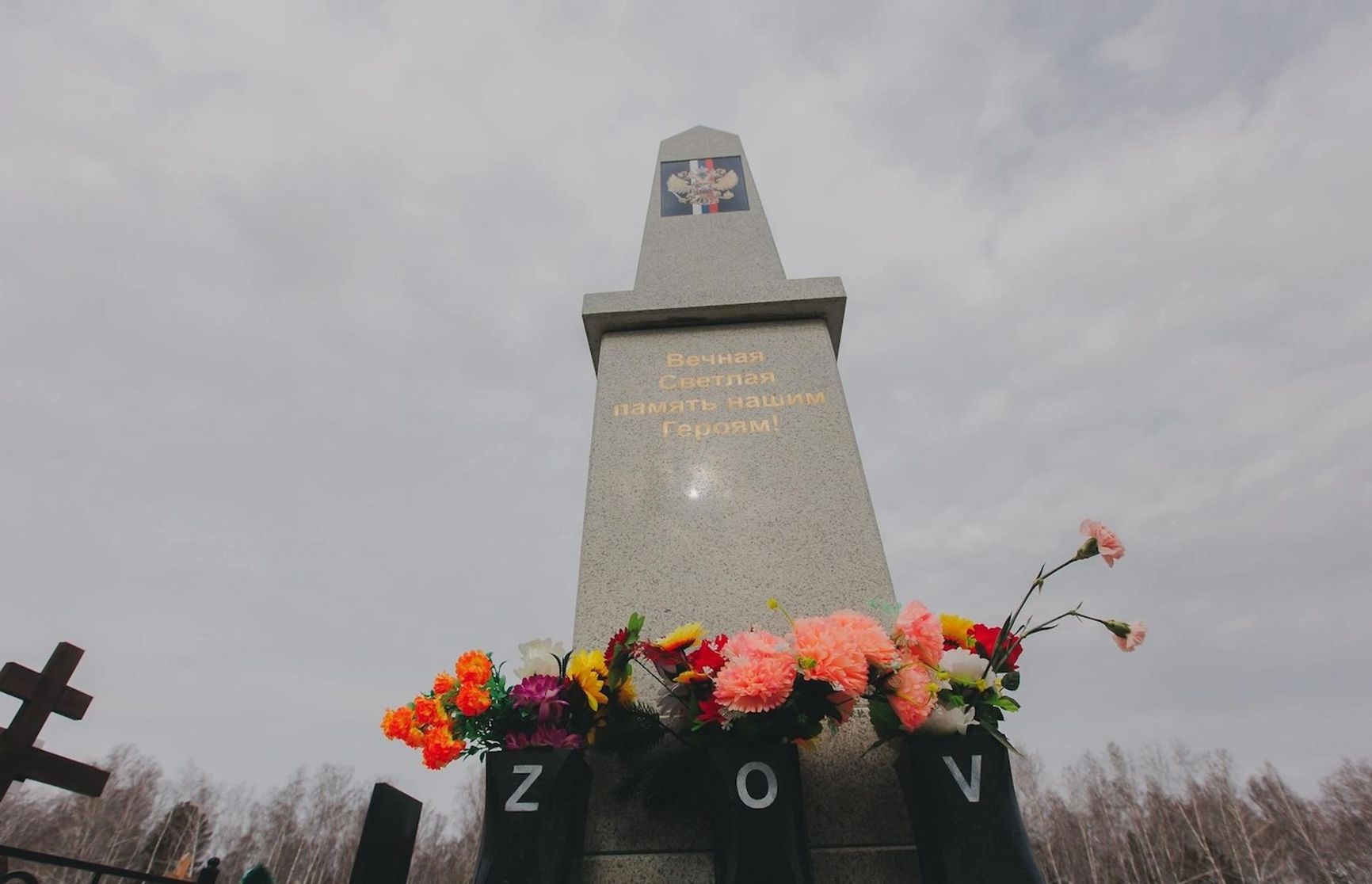
In Chelyabinsk, an additional fee was introduced for burials in the military section of the cemetery, named “ZOV Alley.” A burial plot there costs 100,000 rubles ($1,306), plus another 4,000 rubles ($52) per year for maintenance. In Ryazan, those killed in the war are buried in a separate section of the Bogorodskoye Cemetery, which is managed by a company that charges families 800,000 rubles ($10,450) for installing a headstone.
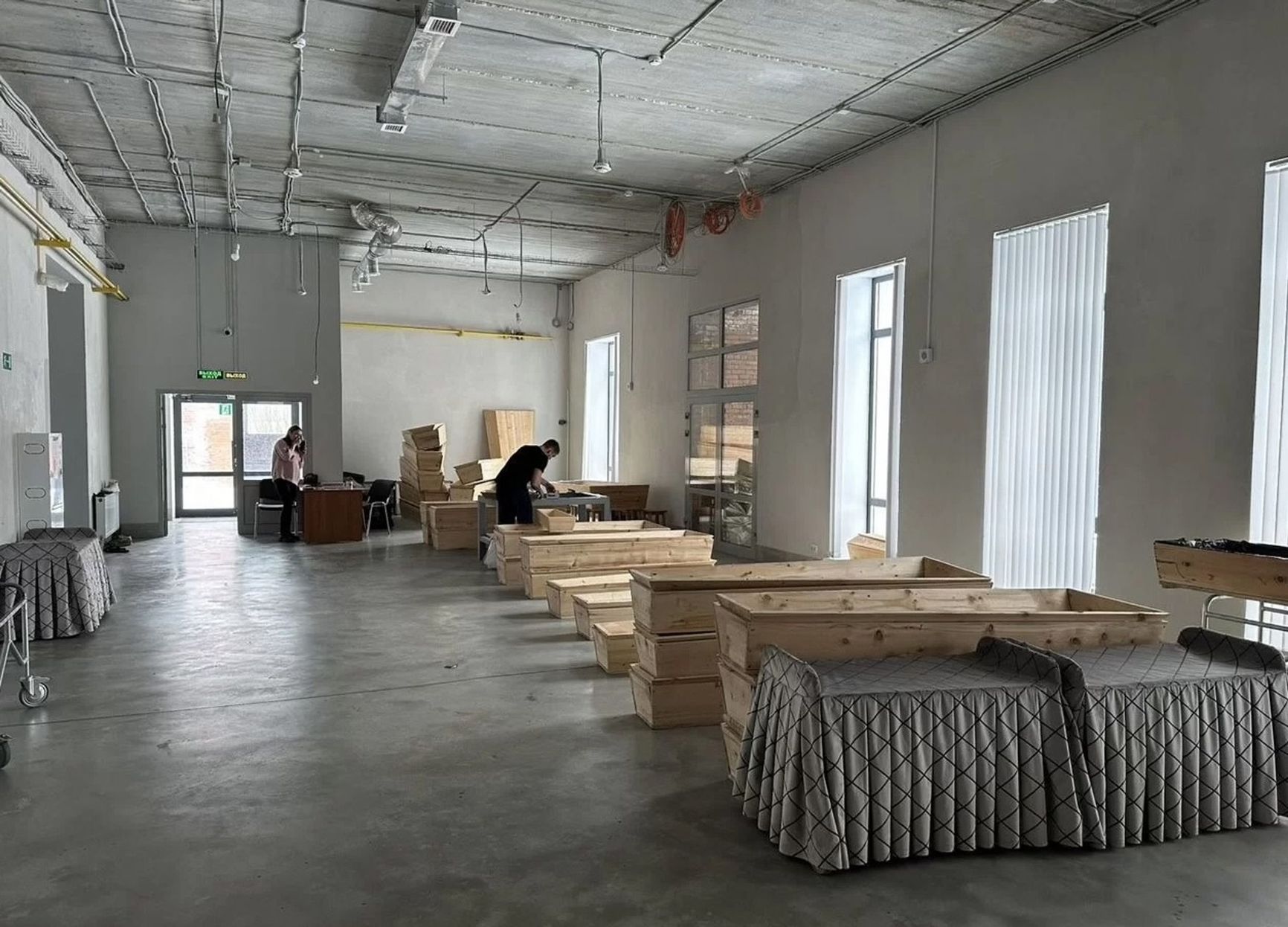
The bodies of most Russians killed in the war are taken to a giant morgue in Rostov-on-Don — the 522nd Center for the Reception, Processing, and Forwarding of the Dead — where the remains are identified before being sent to relatives. The bodies often arrive burned or in an advanced state of decomposition, and the center does not attempt to conceal the damage. There is neither the necessary funding nor the personnel for that, restorative specialist and funeral coordinator Evgeny told The Insider: “The bodies are delivered exactly as they are. After that, the families have to look for someone on their own and pay for it. Or they bury them in a closed coffin.”
Many funeral care specialists actively support the war in Ukraine and consider preparing the bodies of those killed there to be volunteer work. Some well-known practitioners restore burned or decomposed remains free of charge — and even film the process. At the beginning of the war, the profession of funeral practitioner seemed to be an extremely promising employment route, and course organizers said there was no shortage of people wanting to train. But later, such specialists turned out not to be in great demand. As Evgeny noted:
“There isn’t much work, and the pay is low. In the regions it’s 40,000–50,000 ($522-6-53) rubles per month. We’re honest about this in our courses. Mostly, people come who are already used to dealing with bodies — nurses, police officers — or those from the beauty industry, like makeup artists and manicurists. And usually for ideological reasons. Often it’s connected to personal experience, like when a relative died and they saw how awful the body looked.”
Western brands of mortuary cosmetics left Russia back in 2022, and Chinese replacements have not proven to be adequate substitutes. Some specialists import supplies through gray schemes via Kazakhstan, but most have switched to cosmetics designed for living people. “It used to be considered wrong, but now everyone is used to it,” Evgeny said.
Oksana Tomilina, a restorative specialist from Novosibirsk, is a fervent supporter of the war. She works for free and at one point even tried to go to the front herself. That did not, however, save her from involvement in a major scandal at “Necropolis – 2024,” the main industry exhibition for Russia’s funeral sector.
Representing the Novosibirsk crematorium, Tomilina staged a provocative performance at her booth by wearing a costume of the mythological bird Sirin along with a traditional Russian kokoshnik headdress and decorative ribs barely covering her chest. She was accompanied by half-naked male strippers — some with white angel wings and bow ties, others with black wings and horned masks. The booth was titled “Capital of Russian Death.” The exhibition was held at Crocus Expo in October 2024, just six months after the deadly terrorist attack that took place there.
“Capital of Russian Death” referred to Novosibirsk — the city where the Necropolis exhibition was originally conceived, where the industry journal is published, and where funeral directors are trained. No one had taken into consideration the recent attack at Crocus, a source familiar with the event’s organization told The Insider: “It’s professional deformation for us. But then offended believers from Sorok Sorokov showed up, Nikita Mikhalkov spoke out with criticism, and it reached Sobyanin.”
As a result, the Novosibirsk crematorium terminated its contract with Tomilina. But that didn’t help. In 2025, every major Moscow venue refused to host Necropolis. The final exhibition was small in scale and took place in the Main Stage concert hall — after all booth content and events had been cleared by lawyers.
A presentation on pet funerals was almost removed from the program. It was supposed to be titled “Run Across the Rainbow, My Friend,” but the lawyers were concerned about potential LGBT “propaganda.” Despite the precautions, when the title of one of the booths — “Coffins for the Special Military Operation: Practical, Affordable and Convenient for Transport” — entered the public sphere, the pro-war community was outraged by the very idea of discussing the practicality of coffins.
The booth titled “Coffins for the Special Military Operation: Practical, Affordable and Convenient for Transport” outraged the pro-war community
“Even the traditional restorative-arts competition was held behind closed doors, without spectators. But at least the contestants worked not on mannequins, but on real bodies — unclaimed corpses,” a source familiar with the exhibition told The Insider. According to him, the most flamboyant exhibits were a monument to Yevgeny Prigozhin and a luxury coffin made of solid oak with crocodile leather trim.
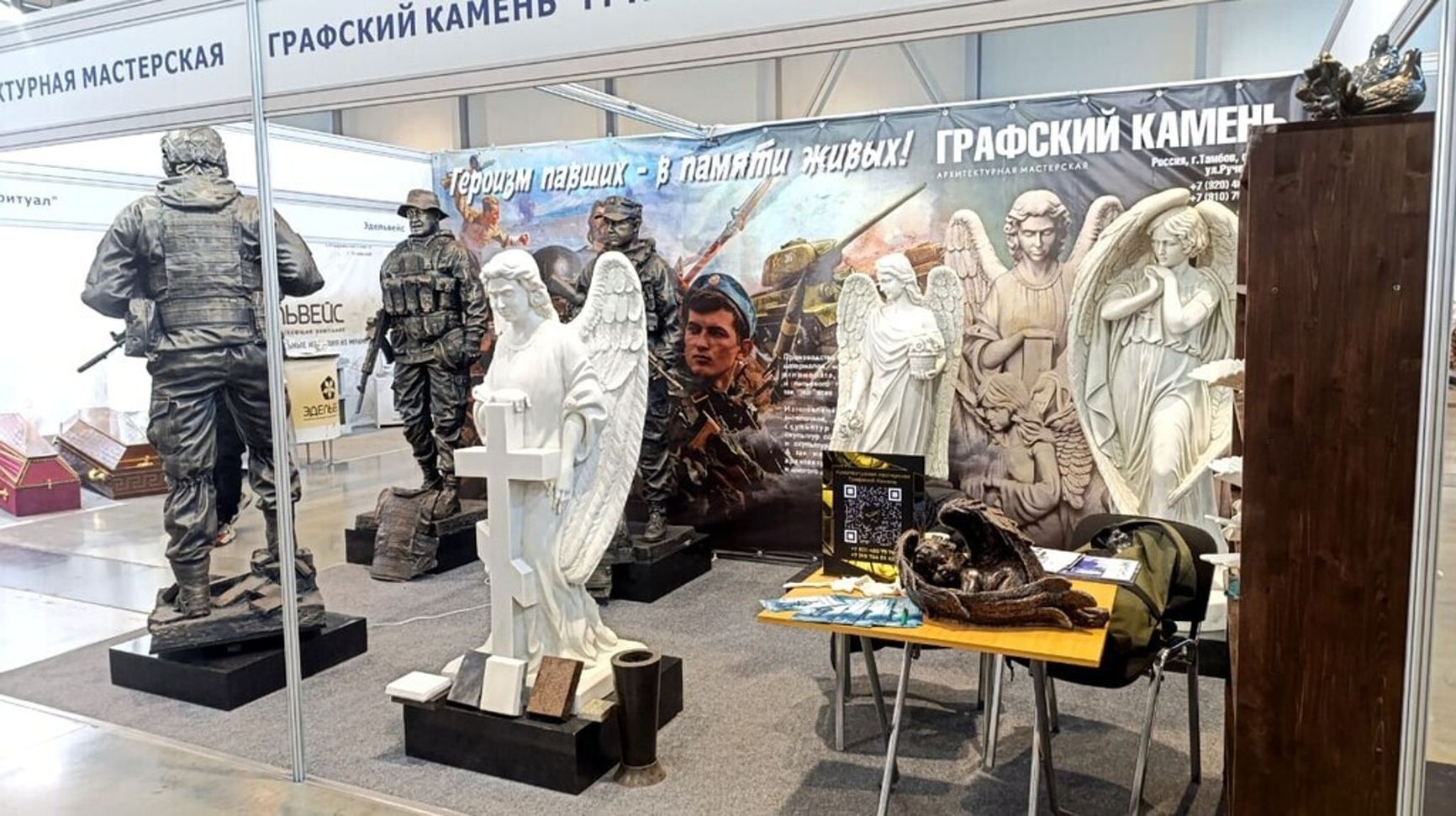
A life-size figure of Prigozhin was presented by the company Grafsky Kamen, which produces budget sculptures made of cast composite stone (similar to the material used for countertops). Over the course of the war, the company has mastered a new niche: monuments to soldiers. They look like toy figurines, with the sculptors placing special emphasis on body armor, helmets, and other gear.
Life-size figures cost between 700,000 and 950,000 rubles ($9,144 to $12,410), Grafsky Kamen told The Insider, though if a family wants a specific person rather than an abstract soldier, an additional 50,000 rubles ($653) is charged for likeness work. The monument takes a month to produce and is shipped to the required city as part of a shared cargo delivery.
At the beginning of the war, the Russian funeral market saw a surge of patriotic products: coffins in camouflage or in the colors of the tricolor, with the letters Z and V emblazoned on the lids. But none of it found demand. Today, military funerals tend to differ from the civilian version only by the flag that is placed on the coffin. The letters Z and V and the orange-and-black St. George’s ribbon are reserved for wreaths.
There is no sign of a religious revival either. On the contrary, secular farewells are becoming more common, a trend that was noted by funeral director Svetlana: “Young people don’t want a church service or burial in the ground. They want cremation, and for the ashes to be scattered.”
Crematoria continue to be built across Russia. At present, there are 38 in the country (the most recent of which opened on Nov. 27, 2025 in Ulyanovsk), with another 36 projects at various stages of completion, funeral industry expert Grigory told The Insider. Sanctions imposed by Czech manufacturers of cremation furnaces after the full-scale invasion did not stop the industry — instead, three new Russian companies emerged.
The Murmansk crematorium developed the Aranga furnace for its own needs, but later established its production for outside clients as well. Boiler and utilities-equipment manufacturer AUBERG, based in Vladivostok, created their own furnace too. In St. Petersburg, the company Renovo-Service, which previously imported Czech equipment, launched its own production of cremation furnaces. According to the company’s website, its new achievement is the “Trizna” automated cremation management system, developed in 2024.
Notably, 27 of Russia’s 38 crematoria are privately owned, and eight of them opened in the past two years — this despite the fact that private crematoria in Russia do not fully comply with the law, and that there have been court rulings shutting some of them down. In 2023, two such facilities were closed in the Moscow region: Gorbrus in Balashikha and Kamenny Tsvetok in Domodedovo. Another private crematorium in the Ramenskoye district was preparing to open in 2023 but never went into operation.
Twenty-seven of Russia’s 38 crematoria are privately owned, and eight of them have opened in the past two years
Authorities in the Moscow region have won every court case against the owners of private crematoria. Russian law classifies such facilities as burial sites, which may belong only to the state or a municipality.
There is, however, a counterexample from elsewhere in the country. In the Rostov region, the municipal Cemetery Service attempted to shut down a new private crematorium through the courts, but lost when the judge ruled that crematoria without columbaria are not burial sites and therefore are not subject to the legal restrictions regarding ownership.
In 2024, lawmakers sought to protect private crematoria through amendments to the law on public–private partnerships. However, in February 2025 the initiative was sharply criticized in the State Duma, and it has not been revisited since. But construction continues regardless — two new private crematoria in Cheboksary and Krasnoyarsk are fully built but cannot open because of their uncertain legal status, funeral industry expert Grigory noted:
“What motivates investors who keep putting money into private crematoria is unclear. Everyone in the market is asking this question, especially since the industry’s profits fell several years ago.”
At first glance, talk of declining profits seems to run contrary to rising mortality and growing funeral-industry turnover, but the current surge in death is far smaller than the spike seen during the coronavirus pandemic. In 2020, mortality in Russia rose by 18 percent — to 2.1 million deaths — and in 2021 it increased another 15 percent, reaching 2.4 million. It was against this backdrop that investors began pouring money into crematoria. But then the pandemic ended, mortality fell below pre-COVID levels, and even with the war, funeral directors are not seeing the same level of demand.
This effect is confirmed by the demographer interviewed by The Insider:
“Apparently, in the post-pandemic period there was a ‘harvesting effect’ — many people with weakened health who, under normal circumstances, might have lived several more years, died. Another possible explanation: during COVID the share of cremations increased because of stricter sanitary rules.”
Some signs of stagnation in the industry are already clear. For example, in Tomsk a crematorium was put up for sale on the online marketplace Avito for 370 million rubles ($4.8 million). The listing claims a payback period of seven months, but that marketing pitch is overly optimistic. According to the Funeral Trust Telegram channel, in 2025 the facility incurred large debts while running serious losses — more than 40 million rubles ($522,500) that year alone.
Construction of the Tomsk crematorium began at the height of the coronavirus pandemic. It opened in 2022 but never brought its owners a profit. In the spring of 2025, a leasing company even tried to sell the cremation furnace separately, but later withdrew the listing.
In November, a plot of land 50 kilometers from Omsk was put up for sale on Avito for a future crematorium. The parcel belonged to partners of Siberian billionaire Viktor Shkurenko,who owns retail stores, coffee shops, and two operating crematoria (one in Yakutsk, and the one in Rostov-on-Don that survived thanks to the court’s decision). The businessman had long planned to build a similar facility in Omsk, but for unknown reasons has abandoned the project.
Even so, authorities in several major Russian cities are still looking for investors to build crematoria. Cemetery space is running out, and cremation is one way to solve the problem. In recent months, the administrations of Smolensk and Tambov have shown interest in new facilities.
Cremation is increasingly chosen for cost reasons, Evgeny noted:
“You can bury the urn in an existing grave and don’t need a new headstone — you just add an inscription to the old one. And often the body is cremated in another city. For example, when someone dies in Moscow, they arrange a fake cremation, and then the remains are taken to Nizhny Novgorod, Yaroslavl, Tula, or even Rostov-on-Don to be cremated elsewhere. It ends up being three or four times cheaper than in Moscow.”
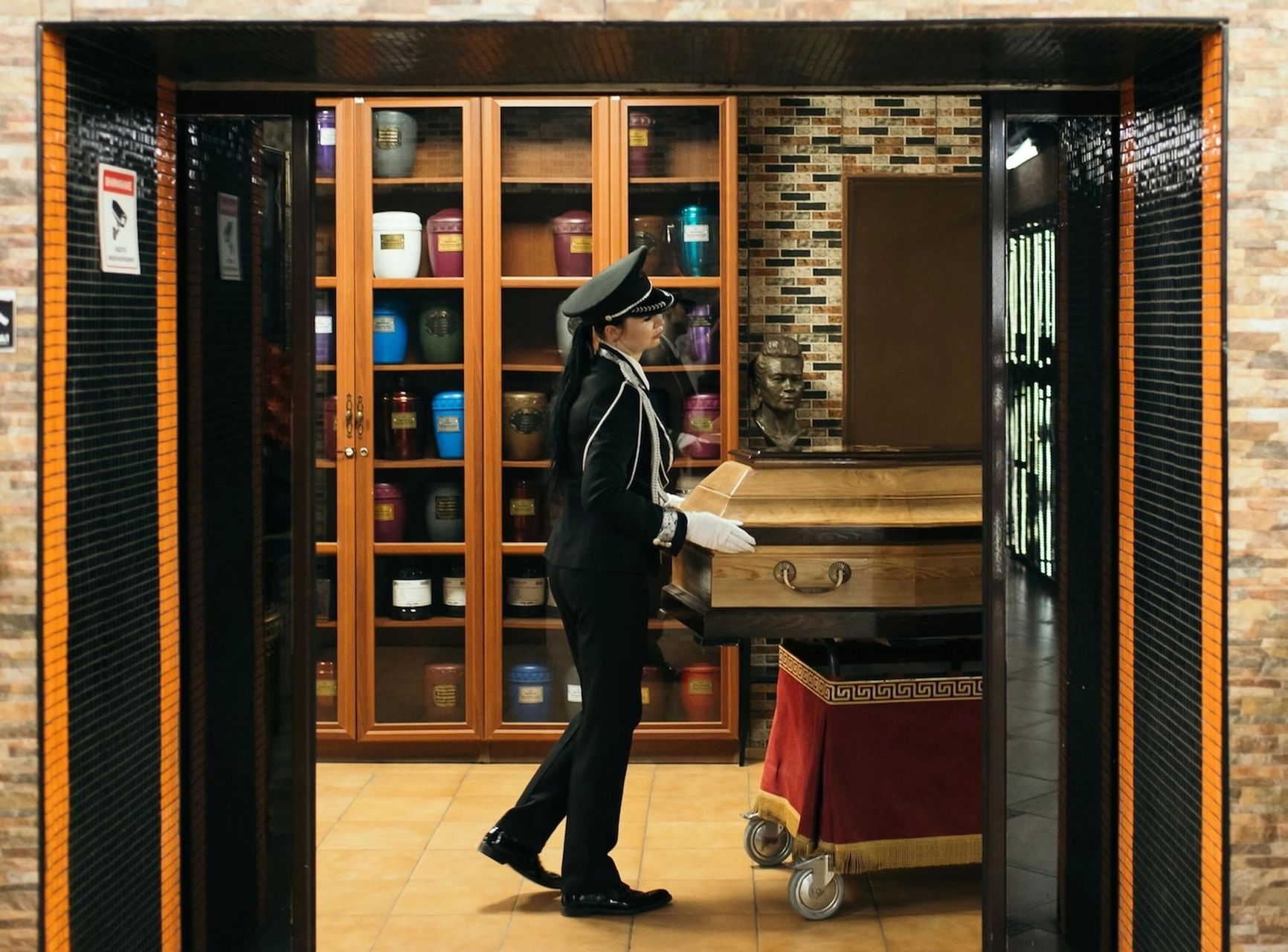
Rostov’s crematorium operates like an industrial facility for burning bodies. There are no farewell halls, no marble, no blue spruces — just a hangar and furnaces. The dead are brought in on special multi-body hearses to keep expenses down.
This kind of cost-cutting defines the entire modern funeral industry, and directors complain that Russia is “losing its funeral culture” because of it. For example, once a hearse delivers the deceased to the cemetery, it no longer waits to take people to the wake, instead rushing off for the next body. Spare parts are getting more expensive, vehicle maintenance too, so workflow has to be optimized.
Another trend is cardboard coffins for cremation costing between 1,200 and 4,000 rubles ($15 to $52). Manufacturers told The Insider that they sell around a thousand units a month, and sometimes demand even exceeds inventory. Suppliers emphasize the environmental advantages: cardboard burns faster and “produces clean ashes with no impurities.” Cardboard coffins can also be used for burial in the ground, though a special wooden frame costing 600 rubles ($8) has to be built into the base.
Another trend is cardboard coffins for cremation
Manufacturers note, however, that interest in their products is not driven solely by ecological concerns. Some municipalities purchase cardboard coffins for the burial of unclaimed bodies, with two models in particular demand: the “Economy” for 1,200 rubles and the “Standard” for 1,700 (the latter has a more durable design and rope handles for carrying).
According to funeral coordinator Evgeny, Russians began cutting back on ceremonial expenses even before the war: “This has been going on for about five years — since the COVID era. People have become less willing to buy expensive stones. Many companies in Russia have developed special social packages with only the basics: an inexpensive coffin, simple accessories, cremation, and an urn. These packages are becoming increasingly popular.”
К сожалению, браузер, которым вы пользуйтесь, устарел и не позволяет корректно отображать сайт. Пожалуйста, установите любой из современных браузеров, например:
Google Chrome Firefox Safari