In early December 2025, a law came into force in Texas banning the sale of medication abortion drugs to residents. Since the summer of 2022, when the U.S. Supreme Court allowed states to set their own reproductive legislation, Texas has become one of the country’s leaders when it comes to restrictions on abortion rights. As of today, the procedure is partially or fully banned in 14 states, leading to a rise in maternal and infant mortality. Experience from elsewhere in the world shows that criminalizing abortion does not increase birth rates, but it does create risks to women’s health and lives, making it harder for them to obtain legal medical care and forcing them to terminate pregnancies underground.
Content
A fundamental shift
Maternal mortality after abortion restrictions
Social inequality: who suffers most
Ideology versus statistics
Experience from elsewhere
In June 2022, the U.S. Supreme Court issued its ruling in the case of Dobbs v. Jackson Women’s Health Organization, granting states the right to independently regulate access to reproductive medicine, including abortion. According to the decision, “the authority to regulate abortion is returned to the people and their elected representatives.” Shortly afterward, several states in the South and Midwest almost completely banned abortion at any stage of pregnancy, while several others introduced bans starting from the sixth week.
Jackson Women’s Health Organization was the last clinic providing abortions in the state of Mississippi. Its representatives filed a lawsuit with the U.S. Supreme Court challenging a state law banning the procedure after 15 weeks of pregnancy. The defendant was Thomas Dobbs, head of the Mississippi Department of Health. Only one question was considered: whether a state may restrict abortions prior to fetal viability, contradicting the rulings in Roe v. Wade and Planned Parenthood v. Casey. Justice Samuel Alito ruled that it may, as the right to abortion is not explicitly spelled out in the U.S. Constitution, meaning the issue falls under the authority of state governments. Six justices supported the decision, while three dissented.
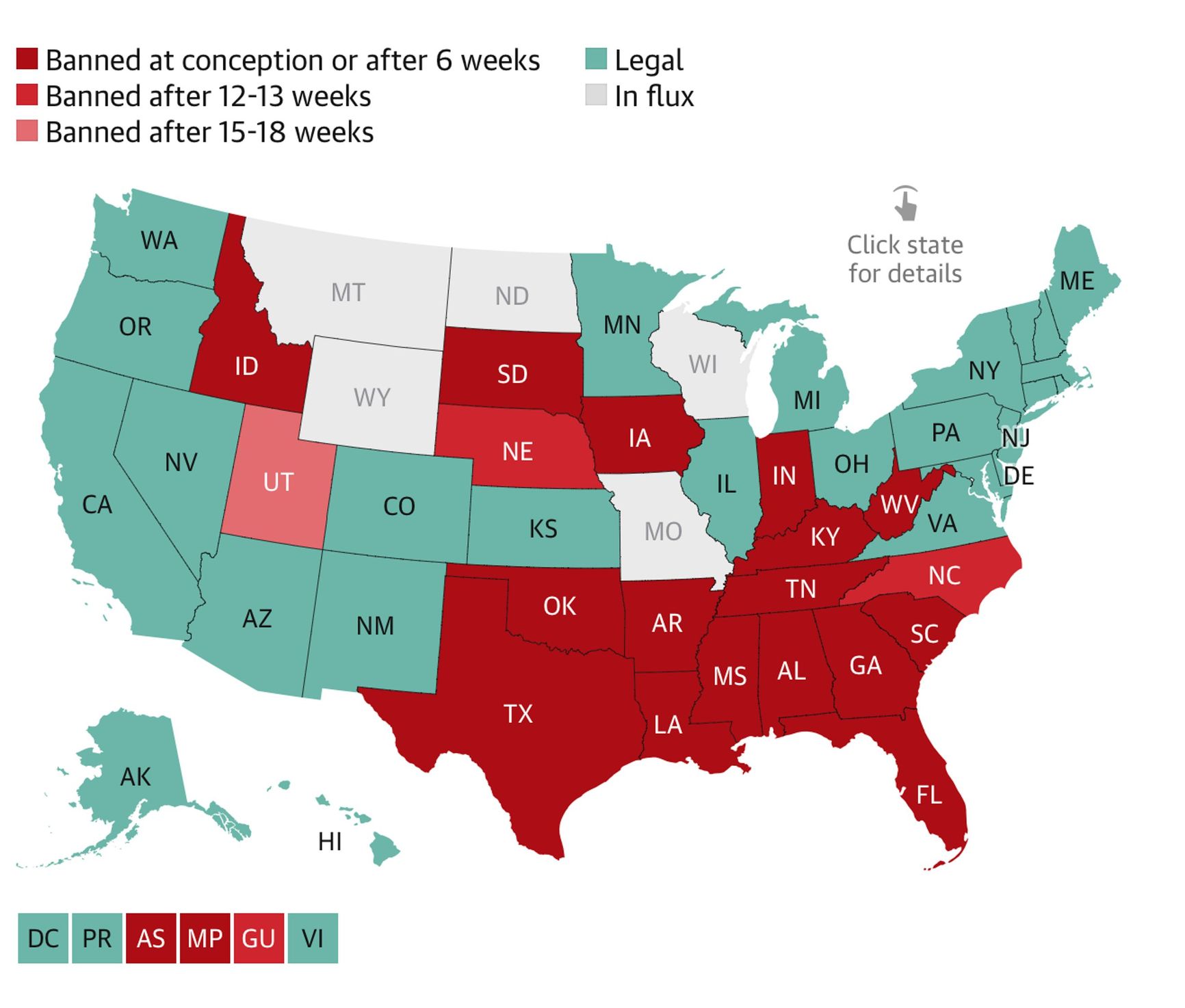
Abortion restrictions in the United States as of 2025. Dark red indicates states where abortions are banned from conception or from approximately the sixth week of pregnancy; red marks bans after 12–13 weeks; burgundy shows bans after 15–18 weeks. Turquoise highlights states where abortion remains legal. Gray denotes jurisdictions where abortion status remains uncertain due to court disputes.
Source: The Guardian
The consequences of granting states “freedom” to regulate abortion were felt almost immediately. Women who encountered bans on terminating a pregnancy or delays in care due to doctors’ fears of criminal liability described the following outcomes: anemia, severe infections, premature rupture of membranes, and life-threatening conditions. The Center for Reproductive Rights recounts the story of a Texas resident:
“During her pregnancy, Samantha learned that her fetus had anencephaly, a fatal congenital condition. Doctors told her that because of Texas’ abortion ban, they were not allowed to perform a termination. Samantha was forced to continue the pregnancy, fully aware that the baby would not survive. She described what was happening as torture. Samantha’s daughter died four hours after birth.”
A fundamental shift
Until 2022, abortion in the U.S. was considered a constitutional right of every woman. This was established by the 1973 ruling in Roe v. Wade, when Norma McCorvey (under the pseudonym Jane Roe) from Texas challenged the state’s abortion ban in the U.S. Supreme Court and won.
The court was asked a single question: “Does a woman have a constitutional right to terminate a pregnancy?” The court answered in the affirmative. The decision was based on the 14th Amendment to the U.S. Constitution, adopted after the Civil War, which prohibits states from interfering with Americans’ fundamental personal liberties.
The Roe precedent formed the basis for a national standard:
• The state may not ban abortions prior to fetal viability (approximately 23–24 weeks);
• The right to abortion is protected by the Constitution throughout the United States;
• Any state laws banning abortion or creating insurmountable barriers to obtaining one in the early stages of pregnancy are unconstitutional.
The liberalization of reproductive rights in the United States led to a significant decline in the number of women dying from illegal abortions — from nearly 200 cases per year in the mid-1960s down to a small handful of isolated cases by the late 1970s.
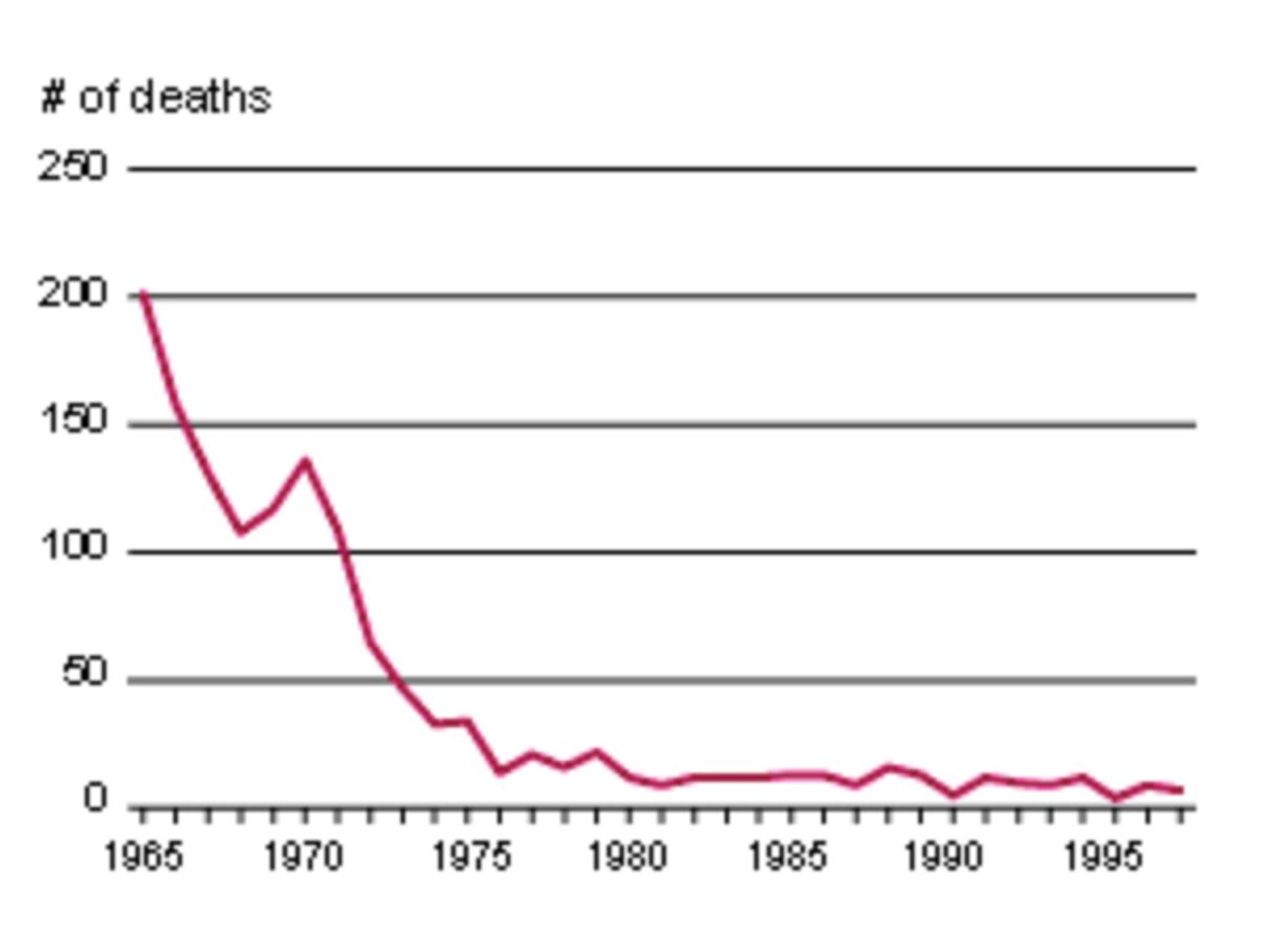
Deaths of women from unsafe abortions in the United States, 1965–1997.
Source: ideas.repec.org
Just under two decades after the Roe decision, Planned Parenthood v. Casey (1992) upheld the earlier ruling while introducing the “undue burden” standard: a state may not place obstacles in a woman’s path to terminating a pregnancy before fetal viability. For nearly half a century, these precedents provided federal protection for women’s access to abortion — that is, until the 2022 Dobbs ruling overturned both decisions.
Maternal mortality after abortion restrictions
In states where abortion bans are in effect, maternal mortality is nearly twice as high as in states where abortion remains legal, according to a 2025 report by the Gender Equity Policy Institute (GEPI). The sharpest increase in deaths was recorded in Texas.
According to data from the Institute for Women’s Policy Research (IWPR), between 2019 and 2022 maternal mortality in the state rose by 56%, compared with an average increase of about 11% nationwide. The reason is that as early as 2021, Texas authorities adopted Senate Bill 8 (SB8), which bans abortion from the point at which fetal cardiac activity can be detected (around the sixth week of pregnancy).
Modern medical guidelines allow for early termination of pregnancy in cases of fetal demise, early rupture of membranes, or severe fetal anomalies in order to prevent hemorrhage, sepsis, and multiple organ failure (1, 2, 3). However, because of the severity of penalties for violating anti-abortion laws — ranging from loss of a medical license to lengthy prison sentences — many doctors fear performing even procedures that are formally permitted.
Because of the severity of penalties for violating anti-abortion laws, many doctors in the United States are afraid to perform even procedures that are formally permitted
In several states, episodes have been documented in which women experiencing pregnancy complications were denied care until life-threatening bleeding or sepsis set in. Two such cases are described by reporting from ProPublica:
“Forced to wait 40 hours as her dying fetus pressed against her cervix, Josseli Barnica risked a dangerous infection. Doctors didn’t induce labor until her fetus no longer had a heartbeat. Physicians waited, too, as Nevaeh Crain’s organs failed. Before rushing the pregnant teenager to the operating room, they ran an extra test to confirm her fetus had expired. Both women had hoped to carry their pregnancies to term. Both suffered miscarriages and both died.”
Statistics from Texas hospitals show that after abortion bans were introduced, the incidence of sepsis among pregnant patients rose markedly as a result of doctors delaying intervention until an immediate threat to a woman’s life emerged.
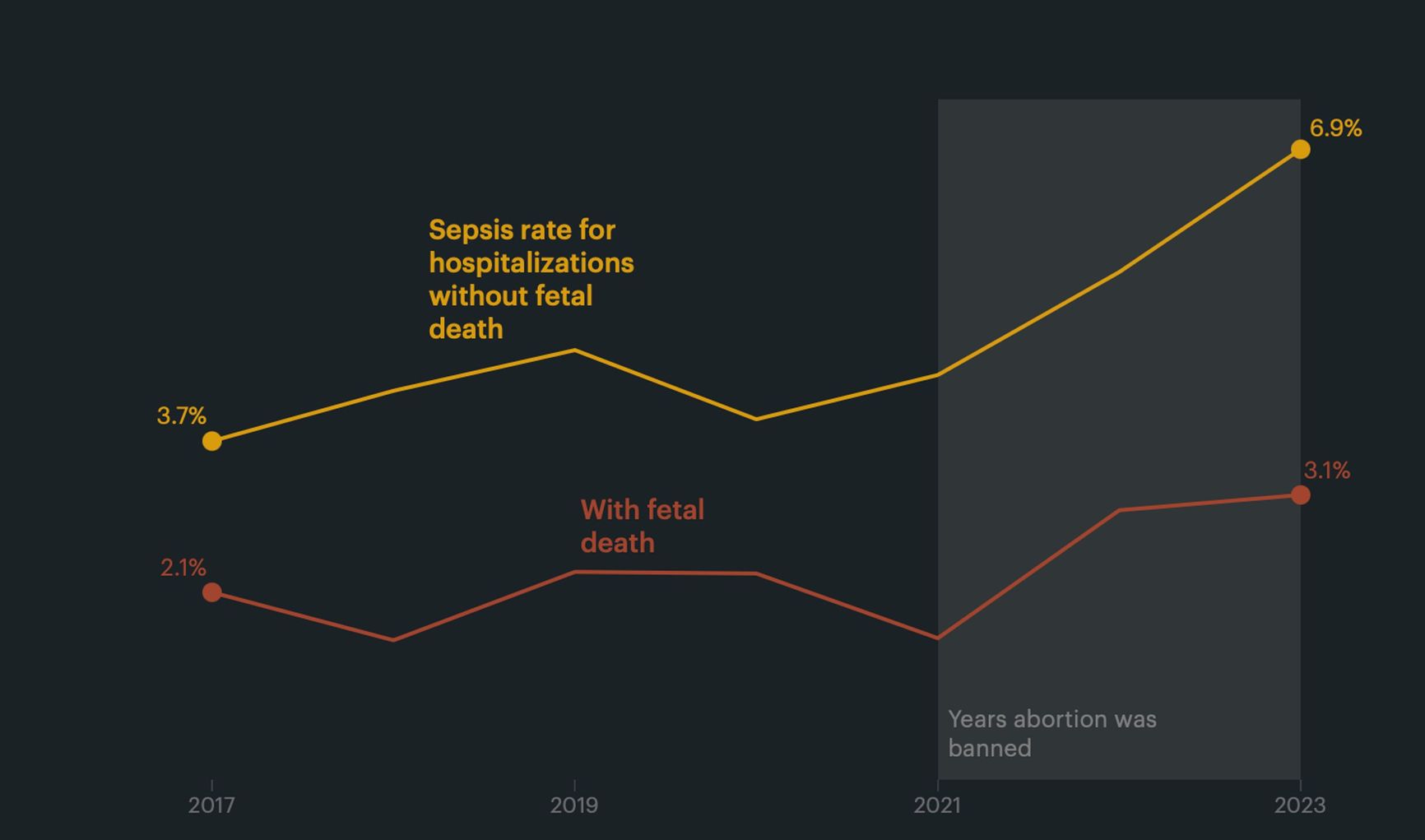
Increase in the incidence of sepsis among pregnant patients in Texas before and after abortion bans. Shares of hospitalizations with and without intrauterine fetal death are shown.
Source: ProPublica
Shilpa Srinivasan and Frank Hyland, researchers at the City University of New York, predict a further rise in maternal mortality and in the number of severe pregnancy complications as a result of abortion bans. According to their estimates, Black women will be particularly affected.
Social inequality: who suffers most
One in eight women in the United States is Black, and one in four of them lives in a state with an abortion ban. According to data from GEPI and the National Partnership for Women & Families, before anti-abortion laws were adopted, Black mothers in these states died at a rate 2.2 times higher than white mothers. After the bans, that figure rose to 3.3.
Before anti-abortion laws were adopted, Black mothers in southern states died at a rate 2.2 times higher than white mothers; afterward, the figure rose to 3.3
This situation is linked to the fact that in southern states, nonwhite people already found it more difficult to obtain health insurance or access maternity services. Bans on terminating pregnancy only worsened the situation, widening the existing gap between different population groups.
In addition, unlike more affluent patients, women from vulnerable groups cannot afford to travel to another state to obtain an abortion. As a result, they are effectively “trapped” in conservative jurisdictions and more often face pregnancy-related complications.
Ideology versus statistics
Conservative politicians frame bans on abortion as “saving children.” At a rally in Texas, Governor Greg Abbott told the crowd: “All of you are life-savers, and thousands of newborn children are the result of your heroic efforts.”
In reality, however, abortion bans lead to higher mortality among both mothers and newborns. According to a study published in JAMA (the Journal of the American Medical Association), in states that adopted anti-abortion laws, infant mortality subsequently rose from 5.93 to 6.25 per 1,000 live births. Researchers estimate that this corresponds to roughly 478 excess infant deaths.
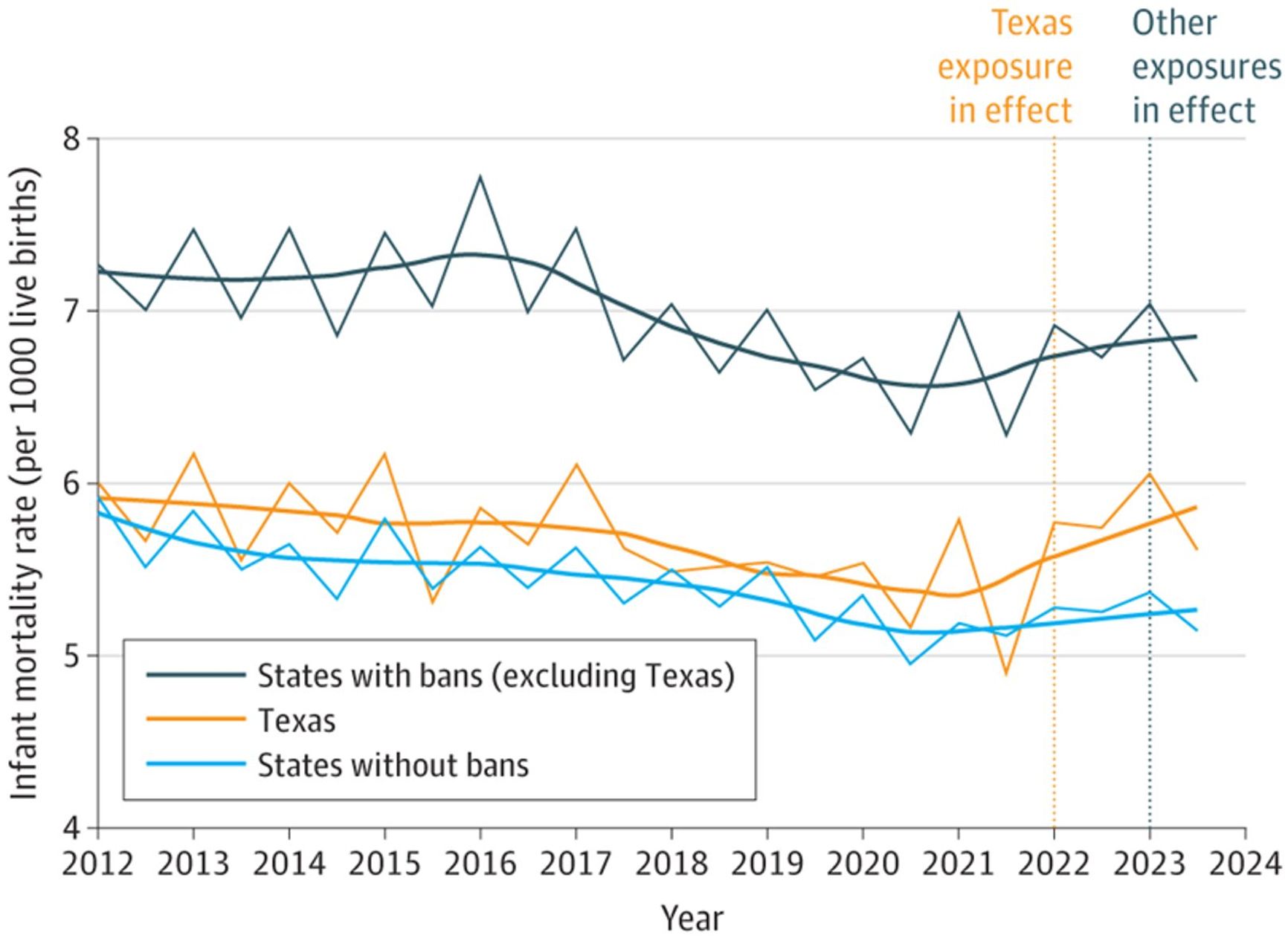
Trends in infant mortality in the United States, 2012–2023: states with anti-abortion restrictions (excluding Texas), Texas, and states without bans. After the Dobbs decision, infant mortality began to rise in states with bans, while the downward trend persisted in states without restrictions. The most pronounced reversal of the trend was recorded in Texas.
Source: JAMA Pediatrics
Birth rates in southern states rose by 1.7%, equivalent to roughly 22,000 “additional” children per year. However, this increase is directly linked to higher mortality. Nearly 11% of infants who died had congenital anomalies. Previously, such pregnancies were terminated for medical reasons.
Opponents of abortion ignore the actual statistics, which show that forcing women to continue pregnancies in settings with weak perinatal infrastructure increases the risk of adverse outcomes for newborns. And legal exceptions allowing abortion “to save the mother’s life” do not, in practice, prevent a rise in female mortality, according to a GEPI report.
As noted earlier, the reason lies in legal uncertainty: doctors make decisions about intervention not on the basis of medical necessity, but out of fear of legal consequences, which directly increases risks for patients.
Experience from elsewhere
One of the world’s harshest reproductive legal regimes is in El Salvador, where abortion is completely banned without any exceptions. Women have received extremely long prison sentences (up to 50 years) for miscarriages and stillbirths, which were classified as murder. As of 2018, at least 27 women remained imprisoned for “violating” the abortion ban.
In 2024, the Inter-American Court of Human Rights (IACHR) found violations of the rights to health, personal integrity, privacy, and access to justice in the case of an El Salvadoran citizen named Beatriz, whose life had long been in danger because of the abortion ban.
In 2013, Beatriz, then 22, who suffered from systemic lupus erythematosus, anemia, and other serious illnesses, learned that her fetus had anencephaly, a developmental anomaly incompatible with life. Doctors recommended an abortion in the interest of the health of the mother, but the Constitutional Chamber of El Salvador’s Supreme Court denied the request due to the complete criminalization of the procedure. Beatriz was later allowed to undergo a cesarean section. The fetus died several hours after the operation, but Beatriz survived. The IACHR demanded that El Salvador’s authorities take steps to prevent similar cases in the future.
In Poland, abortion is permitted only in two cases: if the procedure is necessary to protect a woman’s life or health, or if conception resulted from rape or incest. Severe fetal anomalies are not included among the exceptions, and providing assistance with terminating a pregnancy is punishable by up to three years in prison.
In September 2021, a 30-year-old woman in Poland, known as Izabela, was hospitalized at 22 weeks of pregnancy after her water broke prematurely. The fetus was diagnosed with anomalies incompatible with life. But doctors refused to perform an abortion until the fetus died, despite the threat to the mother’s health. Izabela died of septic shock. The case sparked mass protests against anti-abortion laws under the slogan “Not one more.” In July 2025, the doctors involved in Izabela’s case were held criminally liable. Two were sentenced to prison terms.
Overall, global experience shows that criminalizing abortion invariably leads to a worsening of maternal and infant mortality rates, the spread of illegal and unsafe procedures, and deeper social inequality. The World Health Organization says that although medicine has long possessed methods for terminating pregnancy without harm to women, up to 45% of abortions worldwide are carried out unsafely — illegally, by unqualified providers, and in unsanitary conditions — as a direct result of restrictions on the procedure.
Global experience shows that criminalizing abortion always leads to a worsening of maternal and infant mortality
According to data from the World Health Organization, around 25 million unsafe abortions are performed worldwide each year, resulting in the deaths of about 30,000 women (roughly 10% of all maternal deaths). The WHO’s 2022 guidance emphasizes that criminalizing abortion expands illegal practices, placing women at risk. For medical professionals, bans create fear of criminal prosecution, which in turn reduces their willingness to provide care and lowers the overall quality of that care.