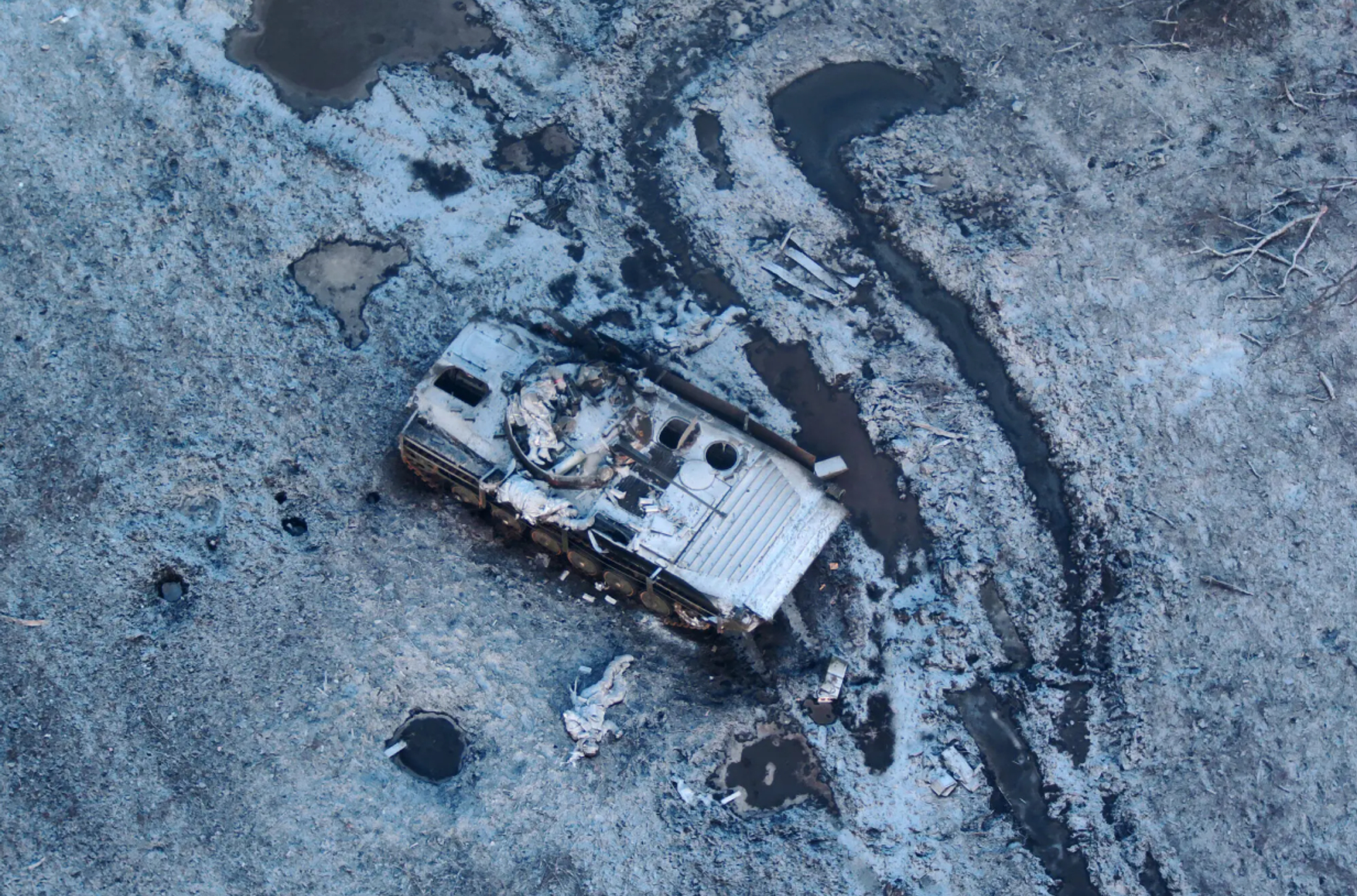
Tyler Hicks / The New York Times
POLITICS
Tyler Hicks / The New York Times
Since early October 2025, Russian authorities have stepped up their claims of battlefield success. Vladimir Putin has held seven public meetings with military officials to hear their apparently triumphant reports. In reality, Russia’s armed forces captured only about 1,000 square kilometers more Ukrainian territory in 2025 than in 2024 — roughly 4,300 square kilometers in total. On a map of Ukraine, that amounts to very modest gains. At the same time, the resources expended to seize that territory were enormous: Russian fatalities alone exceeded 100,000, and up to 20 troops were killed for every square kilometer captured. Sustaining combat operations at this intensity will be difficult, not least because the Kremlin lacks the financial reserves to keep up such an effort for long.
Propaganda at meetings with Putin
Actual territorial gains in Ukraine: 4,300 square kilometers
At least 100,000 killed
War expenditures: 5.1% of GDP
The price of war for Russia: more than 20 dead per square kilometer captured
Since October 2025, Putin has regularly taken part in events highlighting what authorities describe as Russian battlefield successes in its war against Ukraine. During that period, he visited command posts of the Joint Group of Forces in Ukraine three times — on Oct. 26, Dec. 1, and Dec. 27 — made a visit to the “West” command post on Nov. 20, and held meetings on the situation in the so-called “special military operation” zone on Dec. 11 and Dec. 29, as well as a meeting with Defense Ministry and General Staff leadership on Oct. 7.
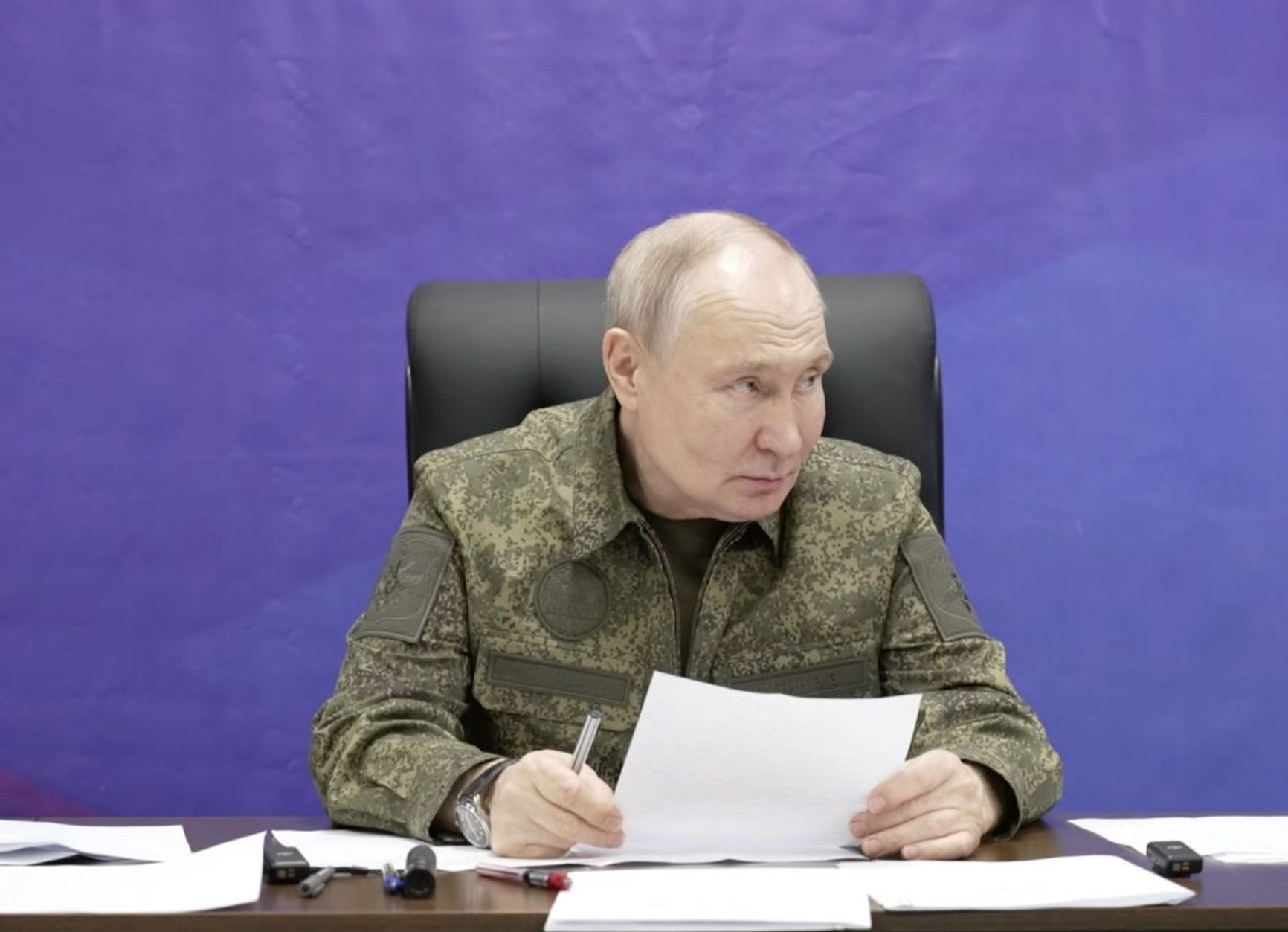
Until March 2025, Putin had consistently avoided wearing military attire, even at events directly related to the war. In connection with his recent tour, however, Putin has appeared on camera in camouflage four times over the past three months alone. There is little doubt the Kremlin is using this image as a tool to influence negotiations with U.S. representatives on a peace settlement in Ukraine. At a camouflage-clad meeting on Dec. 27, 2025, Putin said:
“Judging by the pace we are seeing along the line of contact, our interest in a withdrawal of Ukrainian military formations from the territories they currently occupy is effectively reduced to zero… And if the Kyiv authorities do not want to resolve the matter peacefully, we will achieve all our objectives of the special military operation by armed means.”
Putin himself may believe that the course of the war has turned in Russia’s favor over the past year — after all, that is what his generals report. At a meeting on Dec. 29, 2025, Putin was briefed on the following claimed achievements:
Given this picture of the situation “on the ground,” it is not surprising that the Russian leader signals his readiness to continue fighting until Ukraine’s leadership accepts the Kremlin’s terms for ending the war. Western media have reported the same. But the reality at the front differs markedly from what Putin is being told.
According to estimates by the Ukrainian mapping project DeepState, Russian forces occupied an additional 4,300 square kilometers of Ukraine’s internationally recognized borders in 2025, as well as driving Ukrainian forces out of nearly 500 square kilometers in Russia’s western Kursk Region. That is about 1,000 square kilometers more than in 2024, but wholly incomparable to the territorial gains of 2022, when nearly 62,000 square kilometers were seized. On a map showing all Ukraine, Russia’s advances are visibly marginal.
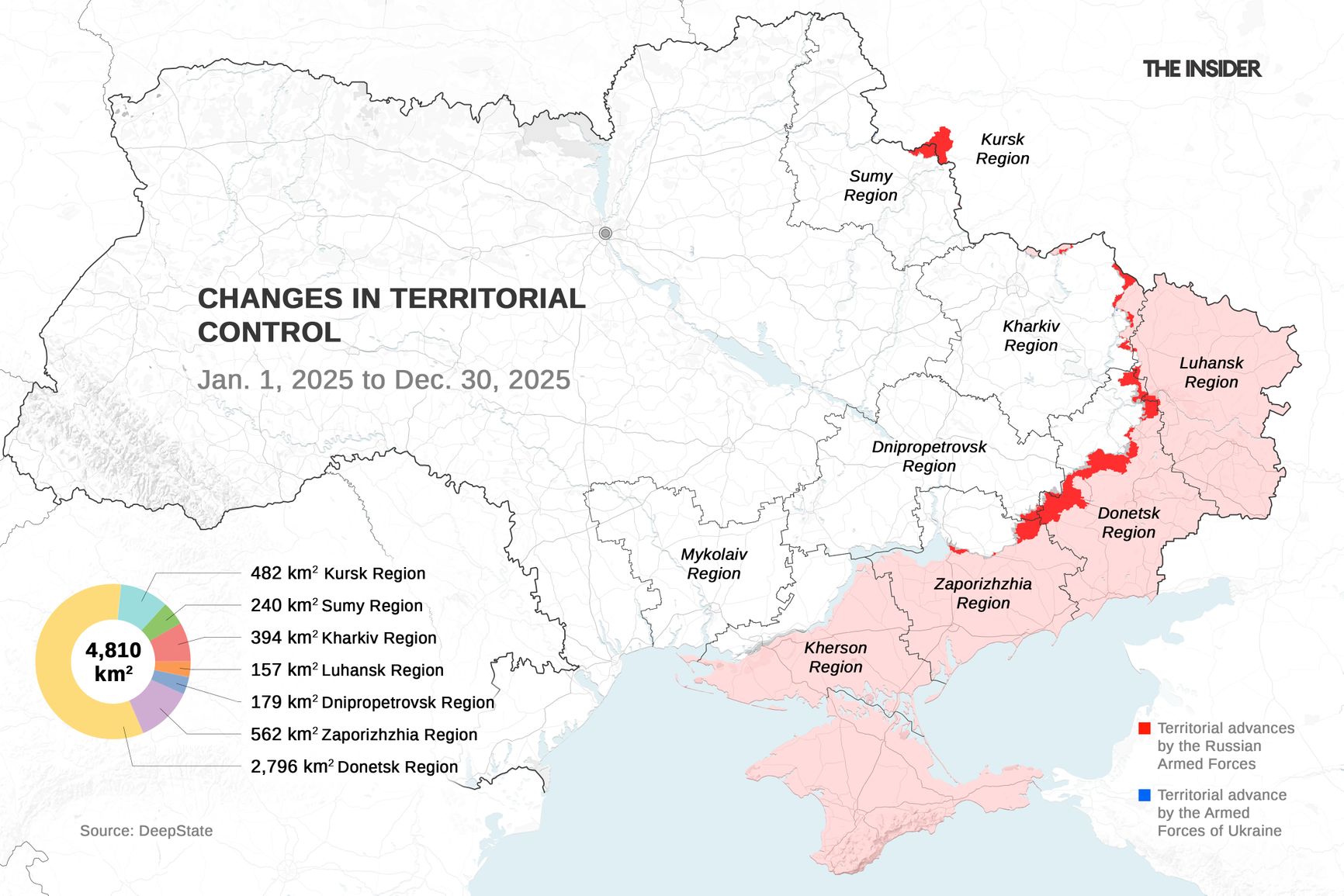
Early in the year, Russia completed an operation to retake control of the Kursk Region, after which combat took place exclusively on Ukrainian territory. Even so, Russian commanders failed to achieve operational-scale successes on any axis. The Kremlin still fully controls only one of the four Ukrainian regions it illegally annexed as federal subjects in October 2022 — Luhansk Region, where 99.6% of the territory is occupied by Moscow’s forces.
The Kremlin still fully controls only one of the four Ukrainian “new regions “ it illegally annexed in October 2022.
Control in the Kherson Region remains unchanged at about 72%, as the sides are firmly separated by the Dnipro River. No major river-crossing operations are expected in the foreseeable future.
In the Zaporizhzhia Region, Russian forces captured 562 square kilometers over the year and now control about 74% of the territory. Forward positions are less than 25 kilometers from the regional capital, Zaporizhzhia, but an assault on the city remains distant, as it would require diverting forces and resources from other sectors, above all from the politically prioritized Donetsk Region.
In the Donetsk Region itself, nearly 2,800 square kilometers were seized in 2025. Even so, Russian forces have yet to fully take control of the Pokrovsk–Myrnohrad agglomeration, where fighting began in spring 2024 as part of a broader Donbas offensive launched in the fall of 2023 following the failure of Ukraine’s counteroffensive. Still, Ukrainian troops continue counterattacks on the outskirts of both cities, while large “gray zones” and mixed pockets of intermingled Russian and Ukrainian positions remain inside urban areas.
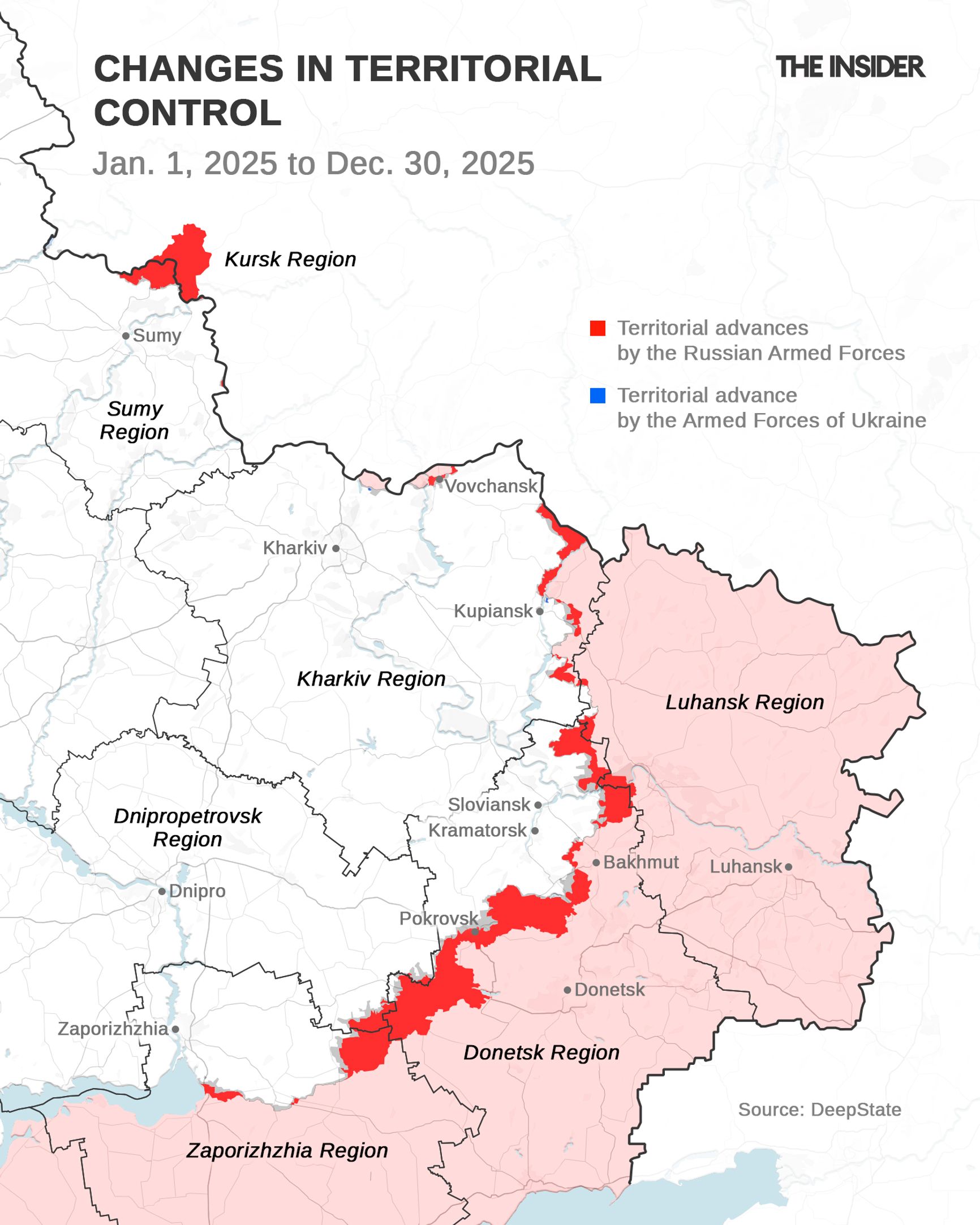
Outside the so-called “new regions,” Russian forces hold only small bridgeheads. There are no full-fledged “security zones” on the approaches to Sumy or Kharkiv, nor along the state border. On the contrary, near Kupiansk in eastern Kharkiv Region, Ukrainian units carried out a full-fledged tactical counterstrike and pushed Russian forces out of a city that Putin had declared captured. In the Dnipropetrovsk Region, Russian troops are focused solely on supporting offensives on other fronts.
In 2025, Russian forces fully shifted to infiltration tactics. While this approach — combined until recently with a return to large-scale mechanized assaults — sharply reduced equipment losses, it resulted in enormous human casualties. At this stage of the war, assault troops’ lives are effectively being expended in place of tanks and armored vehicles, whose use has become extremely difficult on a battlefield dominated by drones.
At this stage of the war, the lives of assault troops are effectively being expended in attacks in place of tanks and armored vehicles.
The Economist and a confirmed casualty-tracking project run by BBC News Russian and the independent outlet Mediazona agree that 2025 was the bloodiest year for Russia’s armed forces since the start of the full-scale invasion. The lower-bound estimate for Russian military deaths stands at 100,000 and will inevitably rise as more information emerges and additional obituaries are published. Total Russian fatalities since February 2022 are estimated to range from 190,000 to 480,000.
2025 was the bloodiest year for Russia’s armed forces since the start of the full-scale invasion of Ukraine.
Notably, the pace of recruitment in Russia last year remained at about 30,000 to 35,000 people a month — but up to 90% of those recruits were put towards replacing ongoing losses in frontline units. As a result, forming new units and building strategic reserves proved impossible.
During a briefing by Russian Defense Minister Andrei Belousov at a meeting on Dec. 17, 2025, officials for the first time presented an estimate of expenditures “directly related to the special military operation”: 11.1 trillion rubles, or 5.1% of GDP. With total budget spending under the “national defense” line item set at 13.5 trillion rubles for 2025, this means more than 80% of defense outlays are going toward the war.
According to estimates by the Re:Russia analytical outlet, the average payment for signing a military contract in the second half of 2025 was 2.2 million rubles. At a recruitment pace of 35,000 people a month, recruiting alone costs budgets at all levels about 460 billion rubles. In other words, maintaining the current inflow of fresh manpower would cost the Kremlin more than 5 trillion rubles a year — exceeding the liquid portion of Russia’s reserves.
As the calendar flips over to 2026, the fighting in Ukraine remains a war of attrition, dominated by precision weapons that are used even against individual targets, including lone soldiers. Large-scale maneuvers are effectively impossible due to the fact that drones provide complete aerial control of the battlefield and tactical rear areas. Positional fighting all but rules out deep breakthroughs, encirclements or collapses of the front, making a decisive defeat of Ukraine’s armed forces an unlikely scenario.
The Kremlin’s strategy of constant, slow advances has yet to deliver its main objective. After all, Ukraine’s state resilience and the functionality of its military machine remain intact. And for Russia, continuing this strategy is likely to require even greater material and human resources than were spent in 2025, as Ukraine’s forces adapt and build an extensive system of fortifications.
The territorial gains achieved in 2025 — about 4,800 square kilometers — came at the cost of more than 20 fatalities per square kilometer. Despite these gains (and these losses), in the Donetsk Region alone, roughly 6,000 square kilometers remain under Ukrainian control. A linear extrapolation suggests it would take about 1.5 years and 120,000 military lives to capture that territory, though numerous factors could significantly slow or accelerate the pace of any hypothetical Russian advance in 2026.
К сожалению, браузер, которым вы пользуйтесь, устарел и не позволяет корректно отображать сайт. Пожалуйста, установите любой из современных браузеров, например:
Google Chrome Firefox Safari