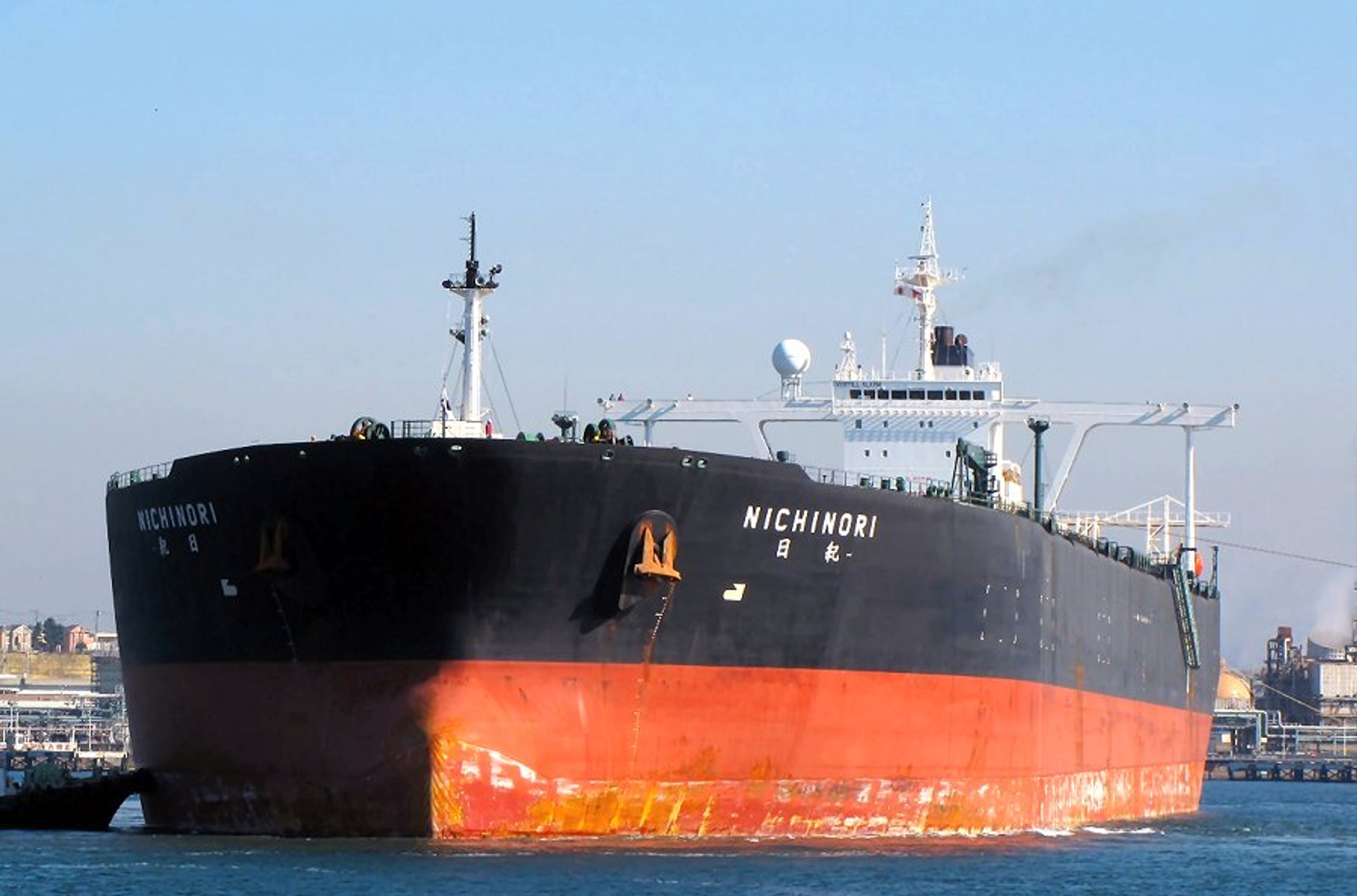
The tanker NICHINORI, later renamed several times and currently operating under the name NORA (IMO 9237539). Photo: Auke Visser’s International Super Tankers
Malaysian authorities have detained two oil tankers suspected of conducting an illegal ship-to-ship transfer and seized a cargo of crude worth approximately $130 million, Reuters reported on Sunday, citing the Malaysian Maritime Enforcement Agency (MMEA). The Insider found that the operation involved a U.S.-sanctioned tanker that is linked to Iran, while the receiving vessel appears on European Union sanctions lists related to Russia.
According to Malaysian authorities, the tankers were found at anchor approximately 24 nautical miles west of Muka Head off the coast of Penang state. The vessels were secured alongside each other in a configuration typical of ship-to-ship oil transfer operations at sea. The origin of the oil was not officially disclosed, and the vessels were not named.
As The Insider ascertained, during the period in question only two oil tankers were present in the anchorage area described by the authorities. These were the tankers NORA (IMO: 9237539) and RCLEBRA (IMO: 9286073).
According to Starboard Maritime Intelligence data reviewed by The Insider, between Jan. 28 and 31 both tankers spent extensive periods in proximity to each other off the coast of Penang, barely changing position and maneuvering at minimal speed. An analysis of AIS data shows that the vessels repeatedly approached one another and remained drifting outside ports for long periods, displaying behavior typical of that seen in ship-to-ship oil transfers conducted directly at sea. During this time, changes in reported draught were recorded for both vessels. In the case of RCLEBRA, the draught increased from 11 to 20.5 meters, indicating the receipt of cargo. Taken together, these indicators point to an oil transfer conducted outside port infrastructure — from a sanctioned tanker to a receiving vessel for onward transportation.
The tanker NORA (IMO: 9237539) is under U.S. sanctions for its involvement in circumventing oil restrictions against Iran and is linked to the National Iranian Oil Company. In sanctions lists and maritime registries, the vessel appears under multiple former names, including NICHINORI, GULF GLORY, GULF FALCON, LONGBOW LAKE, LIMOSTAR, and AROON.
Data from Starboard Maritime Intelligence show that in recent years NORA has rarely called at ports, but that it has spent long periods drifting, repeatedly switched off its AIS transponder, and frequently changed its declared destination. Numerous changes in the vessel’s reported draught were also recorded, a hallmark of ship-to-ship oil transfer operations conducted at sea. Combined, these factors allow the tanker to be classified as part of Iran’s “shadow fleet” for the illicit trade in sanctioned oil.
The other detained tanker, RCLEBRA (IMO: 9286073), is also under sanctions. In European Union documents, it is listed under its former name T CEREAL (previously ROLIN) and is included among vessels involved in transporting oil and petroleum products using the types of so-called “high-risk” shipping practices employed to circumvent sanctions against Russia.
According to open registries, the owner of RCLEBRA is CAPITAL FLAT INTL TRADING, a company registered in the Marshall Islands with a fleet consisting of only one vessel. The operator, technical manager, and holder of the Document of Compliance (DOC) is the Hong Kong–based company Agility Shipping Limited.
Data from Starboard Maritime Intelligence indicate that in recent years RCLEBRA spent long periods drifting, repeatedly changed its reported draught and declared destination, and primarily called at oil terminals in China. This pattern of operation — using a tanker under Russia-related sanctions in conjunction with a sanctioned Iranian vessel — aligns with typical schemes for circumventing oil restrictions by concealing the origin of the crude through ship-to-ship transfers in international waters before the oil is shipped to customers in Asia.
The MMEA reported that the captains of both vessels were detained and handed over to the investigative authorities of Penang state. There were 53 crew members on board the tankers — citizens of China, Myanmar, Iran, Pakistan, and India. Authorities are investigating violations of anchorage regulations and illegal oil transshipment, acts that carry fines of up to 200,000 Malaysian ringgit ($50,740) per vessel.
The ship-to-ship transfer of Iranian oil in international waters off Malaysia is part of an established scheme that is used to circumvent U.S. sanctions. A Bloomberg investigation showed that for several years Iran has been using the South China Sea and the Strait of Malacca for transshipping sanctioned oil from one tanker to another. According to the outlet’s estimates, the volume of such transfers off the Malaysian coast has more than doubled in recent years, with China being the final destination for the vast majority of this crude.
CBS News has documented similar operations, noting that the oil transfers take place far from ports and are carried out with the involvement of the so-called “shadow fleet” — a network of tankers that frequently change names and owners and turn off their AIS transponders. According to CBS, oil transshipped off the coast of Malaysia is later sent to small refineries in China, allowing its Iranian origin to be concealed in an effort to reduce the risk of secondary sanctions against major Chinese companies.